


Top 10 Iconic Indian Desserts and Where They Originated
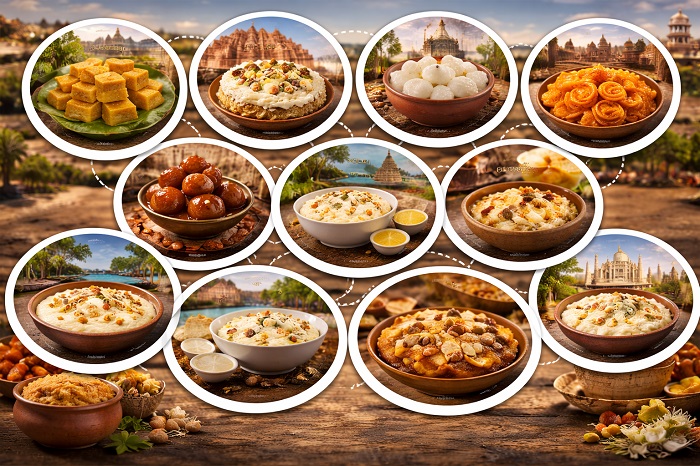

Indian desserts are more than sweet endings to a meal. They carry memory, geography, festival culture, royal influence, and local pride. In India, a dessert is often tied to a city, a season, or a community tradition, which is why the question of origin matters so much. Some sweets are linked to temple offerings, some to royal kitchens, some to street food culture, and some to regional festivals that still define how and when they are eaten. Government and tourism sources continue to spotlight many of these desserts as part of regional identity, from Mysore Pak in Karnataka to Ghevar in Jaipur and Rasagola in Odisha.
What also makes Indian desserts special is their range. Some are milk based and rich, some are fried and syrup soaked, some are grain based and festive, and some are light enough to be eaten daily. Together, they tell the story of Indian food in a way few other categories can. Here are 10 iconic Indian desserts and the places they are most closely associated with.
1. Mysore Pak, Mysuru, Karnataka
Mysore Pak is one of the most famous sweets from South India and is strongly associated with the city of Mysuru in Karnataka. Incredible India identifies Mysore Pak as a specialty of Mysuru and also describes it as originating from the regal city of Mysore.
What makes Mysore Pak so iconic is its simplicity. It is built from gram flour, sugar, and a generous amount of ghee, yet the result can be deeply rich, crumbly, and luxurious. Depending on the style, it can be dense and traditional or softer and more melt-in-the-mouth. Its connection with Mysuru gives it a strong royal aura, and even today it remains one of Karnataka’s most recognized dessert identities.
2. Ghevar, Jaipur, Rajasthan
Ghevar is one of Rajasthan’s most visually distinctive sweets and is especially linked to Jaipur. Rajasthan Tourism says Ghevar is a very popular Rajasthani sweet whose roots can be traced back to Jaipur, and notes its strong association with Teej and Raksha Bandhan.
Made from flour, ghee, and sugar syrup, Ghevar has a beautiful honeycomb-like texture that makes it unlike almost any other Indian dessert. It is often topped with rabri, mawa, or malai, turning it into a festive showpiece. More than a dessert, Ghevar is part of Rajasthan’s seasonal and celebratory food culture, which is why it remains one of the state’s strongest sweet symbols.
3. Rasagola, Odisha
Few Indian desserts carry as much regional passion as Rasagola. Odisha government material has strongly documented the state’s claim to Rasagola, describing it in the context of temple tradition and cultural identity. The Odisha Review specifically presents Rasagola as part of Odisha’s heritage and records the long-running debate around the sweet’s origin.
The Odia version is closely connected with the Jagannath tradition and is often discussed not only as a sweet but as a ritual offering. Soft chhena balls cooked in syrup may sound simple, but the dessert has become one of India’s most debated and beloved sweets. Its importance goes well beyond taste because it represents how deeply dessert can be tied to regional history.
4. Gulab Jamun, Ujjain, Madhya Pradesh
Gulab Jamun is one of the most universally loved desserts in India, and India.gov specifically identifies it as a famous dessert dish of Ujjain. That official association gives it a strong regional anchor, even though the sweet is now found across the country.
Made from khoya or milk solids, shaped into balls, fried, and soaked in fragrant syrup, Gulab Jamun is the kind of dessert that appears at weddings, festivals, restaurant meals, and family gatherings alike. Its appeal lies in comfort and indulgence. Warm Gulab Jamun has become almost synonymous with celebration in India, which is why it easily earns a place on any iconic list.
5. Payasam, Kerala
Payasam is one of Kerala’s most beloved desserts and an essential part of festive meals in the state. Kerala government-linked food safety material explicitly refers to payasam as a popular dessert, especially in the context of Onam season.
Though many variations exist, the essence of payasam lies in a sweet pudding-like preparation made with milk, coconut milk, jaggery, rice, lentils, vermicelli, or other local ingredients. In Kerala, it is not just a dessert but a ceremonial food. It carries a sense of hospitality and festivity, and that deep everyday relevance is what makes it truly iconic.
6. Elaneer Payasam, Coastal Tamil Nadu
Tamil Nadu’s culinary tourism brochure, published in 2026, identifies Elaneer Payasam, a tender coconut dessert, as having evolved in coastal Tamil Nadu. That makes it one of the clearest officially attributed regional dessert forms on this list.
This dessert stands apart because it is lighter and fresher than many rich Indian sweets. Tender coconut adds a delicate sweetness and soft texture that makes it especially appealing in warm weather. It shows how regional ingredients shape dessert styles, and how coastal food culture can create something elegant without relying on heavy richness.
7. Jalebi, North India
Jalebi is one of the most instantly recognizable sweets in India and remains especially rooted in North Indian food culture. Incredible India’s Punjab and other state pages continue to present jalebi as a classic local sweet found in many northern food traditions.
Its crisp exterior, syrup-soaked interior, and bright spiral form make it one of India’s most dramatic desserts. It is sold everywhere from old city sweet shops to roadside breakfast stalls, and in some regions it is paired with poha, rabri, or milk. Jalebi’s exact historical path is wider than a single city today, but in modern Indian food culture it is one of North India’s most defining sweet icons.
8. Malpua, North and East India
Malpua is a classic Indian dessert with strong visibility across North and East India. Incredible India’s Chitrakoot food guide describes it as an Indian specialty and highlights it as a well-loved sweet in that regional culinary setting.
Essentially a sweet fried pancake, often soaked in syrup and sometimes served with rabri, Malpua carries an old-world charm. It is especially associated with festivals and traditional feasts. The dessert feels rustic yet festive, and its continued popularity shows how older styles of Indian sweets still hold emotional power in regional cuisines.
9. Chenna Jhili, Nimapada, Odisha
Chenna Jhili deserves a place here because Incredible India’s Puri food guide directly identifies it as hailing from Nimapada, a town near Puri in Odisha. The same source describes it as a jalebi-like sweet made from cottage cheese.
This dessert is a good reminder that Indian sweets are not only about the most nationally famous names. Some of the most interesting desserts come from smaller towns with strong local identity. Chenna Jhili has the richness of chhena, the sweetness of syrup, and the visual appeal of spiral-style frying, giving it a distinct place in Odisha’s dessert map.
10. Rabri, North India
Rabri is one of India’s most luxurious milk-based desserts and remains deeply identified with North Indian sweet culture. Rajasthan educational and culinary materials list rabri among familiar Indian desserts, while Incredible India pages frequently pair it with sweets like jalebi and malpua.
Made by slowly reducing milk until it thickens into layers, then sweetening and flavoring it, rabri represents patience and richness. It can be served alone or used as a topping for Ghevar, Malpua, or Jalebi. Even when not tied to one single origin city in the same way as some others on this list, it remains one of the most iconic desserts of the North Indian sweet tradition.
Conclusion
Indian desserts are not just famous because they taste good. They last because they are tied to places, rituals, ingredients, and regional memory. Mysore Pak belongs to Mysuru’s royal identity, Ghevar to Jaipur’s festive culture, Rasagola to Odisha’s heritage, and payasam to the ceremonial life of Kerala. Together, these sweets show that dessert in India is not an afterthought. It is a cultural map in itself.