






Stolen Masterpieces Worth Billions: The World’s Most Expensive Missing Paintings

Art theft occupies a strange space between crime and cultural tragedy. Unlike the theft of money or jewels, the stealing of a painting often creates a mystery that can last decades, even centuries. These are not just objects that disappear—they are irreplaceable pieces of human history, each carrying artistic, cultural, and historical significance.
Today, art theft is considered one of the largest underground criminal industries in the world, frequently compared to drug trafficking in terms of global scale. What makes it even more complex is that the majority of stolen artworks are never sold in traditional markets. Instead, they disappear into a shadowy network where value is measured not just in money, but in influence, leverage, and secrecy.
Understanding the most expensive stolen paintings, therefore, requires more than listing their price tags. It involves examining how they were stolen, why they were targeted, and what likely happened to them afterward.
The Isabella Stewart Gardner Heist: A Turning Point in Art Crime

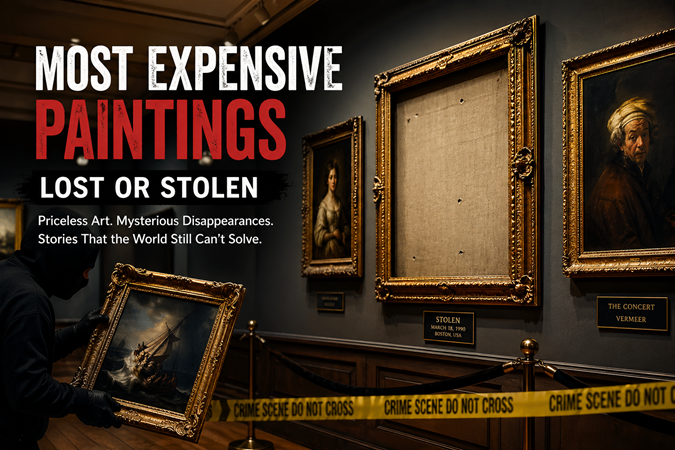
In the early hours of March 18, 1990, the Isabella Stewart Gardner Museum became the site of what is widely regarded as the most significant art theft in modern history. Two men posing as police officers gained entry by convincing a security guard they were responding to a disturbance. Once inside, they restrained the guards and moved freely through the galleries for over an hour.
What makes this heist particularly remarkable is not just its scale—13 artworks worth over $500 million were stolen—but the precision of its execution. The thieves appeared to have prior knowledge of the museum’s layout and security weaknesses. They selectively removed specific works, including masterpieces by Johannes Vermeer and Rembrandt van Rijn, while ignoring other equally valuable paintings nearby.
Among the stolen works, The Concert stands out as one of the most valuable missing paintings in the world. Its significance lies not only in its artistic quality but in its rarity. Vermeer produced a relatively small body of work, and very few of his paintings are available outside major museum collections.
Equally important is The Storm on the Sea of Galilee, notable for being Rembrandt’s only known seascape. The removal of these works left behind empty frames that still hang in the museum today, serving as a deliberate reminder of the loss.
Despite decades of investigation, including involvement from the FBI, the case remains unresolved. Authorities have suggested links to organized crime, reinforcing the idea that such thefts are rarely isolated incidents but part of larger criminal ecosystems.
Caravaggio’s Lost Nativity and the Role of the Mafia

The theft of Nativity with St. Francis and St. Lawrence in 1969 highlights a different dimension of art crime—its intersection with organized crime syndicates.
Created by Caravaggio, one of the most influential artists of the Baroque period, the painting was housed in a modest oratory in Palermo. Its relatively accessible location made it vulnerable, and it was removed with surprising ease.
Subsequent investigations pointed toward the Sicilian Mafia. Testimonies from informants over the years have painted a disturbing picture. According to some accounts, the painting was used as a status symbol among high-ranking members of the organization. Other reports suggest it may have been damaged due to poor storage conditions and eventually destroyed.
Although these claims remain unverified, they reveal an important truth about art theft: the fate of stolen works is often uncertain, and in some cases, they may be lost permanently due to neglect rather than deliberate destruction.
The Ashmolean Museum Theft and the Evolution of Modern Art Crime

The theft of View of Auvers-sur-Oise from the Ashmolean Museum in 1999 demonstrates how art crime adapted to modern environments.
The perpetrator exploited temporary scaffolding to gain access to the museum roof, bypassing conventional entry points. By using a smoke device to trigger alarms and delay response, the thief created a narrow window of opportunity to locate and remove the target painting.
The choice of a work by Paul Cézanne was not random. Cézanne is widely regarded as a foundational figure in the transition from traditional to modern art. His works are highly valued not only for their aesthetic qualities but for their historical importance in shaping artistic movements such as Cubism.
This case illustrates how art thieves often possess a degree of knowledge about art history and market value, enabling them to identify works that offer maximum leverage within illicit networks.
Van Gogh and the Paradox of Recovery Without Resolution

In 2002, two paintings were stolen from the Van Gogh Museum, highlighting another recurring pattern in art theft: the gap between solving a crime and recovering the artwork.
The paintings, created by Vincent van Gogh during his early period, were taken after the thieves forcibly entered the building. Although the perpetrators were later identified and convicted, the artworks themselves remained missing for years.
This case underscores a key issue in art crime investigations. Even when law enforcement successfully identifies those responsible, the artworks may have already been transferred, hidden, or used in transactions that leave no trace. The recovery process, therefore, often depends on factors beyond the initial investigation, including informants, negotiations, and chance discoveries.
The Ghent Altarpiece and the Historical Scale of Art Theft

The story of the Ghent Altarpiece expands the discussion beyond individual crimes to the broader historical context of art theft.
Created in the 15th century by the Van Eyck brothers, the altarpiece is considered one of the most important works in Western art. Over the centuries, it has been repeatedly targeted during periods of political and military conflict, including its seizure by Napoleon and later by Nazi forces during World War II.
The most enduring mystery associated with the altarpiece is the disappearance of the panel known as the “Righteous Judges” in 1934. Despite ransom demands, extensive investigations, and numerous theories, the panel has never been recovered.
This case highlights how art theft is not limited to criminal activity in the modern sense. It has also been a tool of political power, with conquering forces using art to assert dominance and cultural superiority.
Why High-Value Art Is Targeted
The selection of artworks in major thefts is rarely arbitrary. Thieves tend to focus on works that combine high financial value with strong recognition. Paintings by artists such as Vermeer, Rembrandt, Van Gogh, and Cézanne meet these criteria because they are both culturally significant and widely known.
However, this creates a paradox. The same visibility that makes these works valuable also makes them difficult to sell. As a result, stolen art often functions less as a commodity and more as an asset within criminal systems.
In many cases, artworks are used as collateral in illegal transactions, similar to how property or financial instruments might be used in legitimate markets. They may also serve as bargaining tools in negotiations with authorities or insurance companies, particularly when rewards are offered for their return.
The Economics and Recovery of Stolen Art
Despite advancements in technology and international cooperation, the recovery rate for stolen art remains low, often estimated at around 10 to 15 percent. Several factors contribute to this.
First, the international nature of art markets complicates jurisdiction and enforcement. Second, the secrecy of criminal networks limits the availability of reliable information. Finally, the physical nature of artworks means they can be hidden, altered, or even destroyed.
Organizations such as the Art Loss Register maintain databases of stolen works to prevent their sale in legitimate markets. Auction houses and galleries routinely consult these databases, which has made it increasingly difficult for stolen art to re-enter the public domain.
However, this has also pushed criminal activity further underground, making recovery even more challenging.
Cultural Loss and the Enduring Mystery
The true cost of art theft cannot be measured solely in financial terms. When a painting is stolen, it is effectively removed from public access, depriving future generations of the opportunity to experience it.
Museums often leave empty spaces or frames where stolen works once hung, serving as visual reminders of what has been lost. These absences are powerful symbols, emphasizing that art is not just an asset but a shared cultural resource.
The enduring mystery surrounding stolen paintings also contributes to their significance. Each missing artwork carries with it unanswered questions about its whereabouts and condition. In some cases, these mysteries become as important as the artworks themselves.
Conclusion
The world of stolen art is complex, involving elements of crime, history, economics, and culture. From the calculated precision of the Gardner Museum heist to the unresolved disappearance of the Ghent Altarpiece panel, these cases illustrate the many ways in which art can be lost.
What unites them is not just their value, but their absence. Each missing painting represents a gap in the collective cultural record—a reminder that even humanity’s greatest achievements are not immune to loss.
Whether hidden in private collections, circulating within criminal networks, or lost forever, these masterpieces continue to shape our understanding of art theft. And until they are found, they remain among the most valuable and mysterious objects in the world.
The Most Expensive Museum Theft in History: The Isabella Stewart Gardner Museum Heist
In the early hours of March 18, 1990, what appeared to be a routine night at the Isabella Stewart Gardner Museum in Boston turned into the most expensive museum theft the world has ever seen. Two men disguised as police officers arrived at the museum, claiming they were responding to a disturbance call. Within minutes, they convinced the security guards to let them inside. What followed was not a rushed burglary, but a calculated operation that unfolded over 81 minutes—an eternity in the world of crime.
By the time the thieves left, they had stolen 13 priceless artworks worth an estimated $500 million. Among them were masterpieces like The Concert by Johannes Vermeer and The Storm on the Sea of Galilee by Rembrandt, the latter being the artist’s only known seascape. The selection of paintings suggested that the thieves had specific targets in mind, rather than acting randomly.
What makes this theft even more fascinating is not just its scale, but its mystery. Decades later, none of the stolen works have been recovered. The empty frames still hang in the museum today, serving as haunting reminders of what was lost. Despite numerous investigations, leads, and even a $10 million reward offered by the museum, the case remains unsolved.
Art experts believe the stolen pieces were never intended to be sold on the open market, as their fame makes them impossible to trade legally. Instead, they may have been used as bargaining chips in criminal networks or hidden away in private collections known only to a select few.
The Gardner heist is more than just a crime—it is a symbol of how vulnerable even the most prestigious institutions can be. It also raises a deeper question: when art disappears, does its value diminish, or does the mystery make it even more priceless?
The Most Expensive Art Heist Ever: When Masterpieces Became Targets
While individual museum thefts like the Gardner heist dominate headlines, the broader history of art crime reveals a pattern of increasingly sophisticated and high-value heists across the globe. The title of the most expensive art heist often overlaps with the Gardner case, but in a wider sense, art theft as a phenomenon represents a shadow economy worth billions.
One of the defining characteristics of high-value art heists is that they are rarely about immediate profit. Unlike traditional theft, stolen paintings cannot simply be sold to the highest bidder. Instead, they often enter a hidden world where art becomes currency—used as collateral in illegal deals, leveraged in negotiations, or held as long-term assets within criminal networks.
Over the years, several major heists have demonstrated how calculated these operations can be. In 2002, thieves broke into the Van Gogh Museum and stole two paintings by Vincent van Gogh in a matter of minutes. Although those works were eventually recovered years later, the case highlighted how even well-guarded institutions can be vulnerable to determined criminals.
More recently, in 2026, reports emerged of a lightning-fast museum theft in Italy where works by artists like Paul Cézanne, Pierre-Auguste Renoir, and Henri Matisse were stolen in under three minutes. The speed and precision of the operation suggest that modern art thieves are becoming increasingly sophisticated, combining planning with technological awareness.
What makes these heists so compelling is the paradox at their core. These paintings are worth tens or even hundreds of millions of dollars, yet they are effectively unsellable. Their value lies not in liquidity, but in their cultural and historical significance.
In this sense, the most expensive art heists are not just crimes—they are disruptions of cultural heritage. Each stolen painting represents a piece of human history removed from public view, often indefinitely. And as long as these masterpieces remain missing, their stories continue to grow, turning them into legends that blur the line between art, crime, and mystery.