



Pokémon Cards Worth Millions: The Most Expensive Sales Ever Recorded at Auction
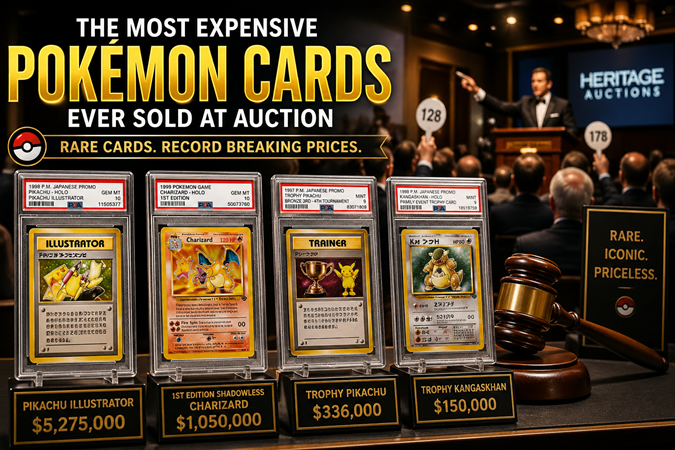

What began as a simple trading card game in the late 1990s has now transformed into one of the most surprising luxury investment markets in the world. Pokémon cards, once exchanged casually among children, are now being sold at international auctions for prices that rival fine art, rare automobiles, and high-end collectibles.
The modern Pokémon card market is driven by a combination of nostalgia, scarcity, grading systems, celebrity influence, and competitive auction dynamics. Over time, a small group of cards has emerged as financial outliers, reaching prices in the millions and reshaping how collectibles are perceived globally.
At the center of this market sits a handful of cards that define the entire industry.
The Pikachu Illustrator Card – The Most Expensive Pokémon Card Ever Sold

The Pikachu Illustrator card is widely regarded as the most valuable Pokémon card in existence and is often referred to as the “holy grail” of the entire franchise.
Pikachu Illustrator Pokémon Card
This card was originally awarded in 1998 during an illustration contest held by CoroCoro Comic in Japan. It was never sold commercially, never included in booster packs, and was only distributed to winners of a special competition. Only around 39 to 40 copies are believed to exist, making it one of the rarest collectibles ever produced in the Pokémon universe.
The most famous example of this card was owned by Logan Paul, who purchased it in a private deal before it later became part of a record-setting auction. The sale was conducted through Goldin Auctions and officially recognized by Guinness World Records as the highest-value Pokémon trading card transaction in history.
Final confirmed value: $16,492,000
This single sale redefined the trading card market and positioned Pokémon cards alongside fine art and luxury investment assets.
Why the Pikachu Illustrator Card Commands Such a High Value

The Pikachu Illustrator card is not valuable because of gameplay mechanics but because of its extreme rarity and historical importance. It was never mass-produced, never sold in retail markets, and was only awarded to a very small number of contest winners in Japan.
Its value is further amplified by the fact that very few copies exist in pristine condition. Cards graded PSA 10, which represent perfect condition with no visible flaws, are exceptionally rare for this particular card. Even minor imperfections can reduce value significantly.
The artwork also adds historical significance, as it was illustrated by Atsuko Nishida, one of the original designers of Pikachu. This makes the card not only a collectible but also a piece of Pokémon’s creative history.
The combination of scarcity, origin, grading rarity, and cultural importance places this card at the absolute top of the Pokémon market hierarchy.
First Edition Charizard – The Most Iconic Pokémon Card Ever Released

While Pikachu Illustrator represents rarity, First Edition Shadowless Charizard represents demand, nostalgia, and emotional value.
First Edition Charizard Pokémon Card
Released as part of the original Base Set in the late 1990s, this card quickly became the most recognizable Pokémon card in the world. Unlike promotional or trophy cards, Charizard was available in booster packs, but extremely limited print runs and widespread childhood usage have made high-grade versions extremely rare today.
In today’s auction market, PSA 10 graded Charizard cards have sold for hundreds of thousands of dollars, often ranging between $200,000 and $500,000 depending on condition and market demand.
The reason Charizard maintains such strong value is not only scarcity but emotional demand. Many collectors purchasing these cards today grew up during the original Pokémon era and are now financially capable adults competing to reclaim pieces of their childhood.
This emotional connection consistently drives bidding wars far beyond expected market valuations.
PSA Grading – The System That Determines Market Value

One of the most influential factors in Pokémon card pricing is professional grading, primarily through Professional Sports Authenticator (PSA).
PSA evaluates cards on a scale from 1 to 10, with PSA 10 representing perfect condition. The grading process assesses centering, surface quality, edges, and corners. Even the smallest defect can significantly impact value.
The difference between grades can be extreme. A PSA 10 card may be worth 10 to 100 times more than the same card in PSA 7 or PSA 8 condition. This grading system has effectively standardized the Pokémon card market and allowed it to function more like structured investment assets rather than informal collectibles.
Grading also plays a critical role in auction confidence, as buyers rely on third-party authentication before committing to high-value purchases.
Trophy Cards – Ultra-Rare Competitive Prizes

Beyond mainstream collectible cards, there exists a category known as trophy cards. These cards were awarded exclusively to winners of official Pokémon tournaments and competitions, primarily in Japan during the early years of the franchise.
Unlike regular cards, trophy cards were never sold or distributed commercially. Each one was awarded in extremely limited quantities, sometimes with fewer than a dozen copies in existence.
Because of this extreme scarcity, trophy cards have become some of the most valuable collectibles in the Pokémon world. Many of these cards have sold privately for six-figure and even seven-figure amounts, although exact values are often undisclosed due to private transactions.
Their value is driven entirely by exclusivity, historical importance, and condition rarity.
Sealed Booster Boxes – Preserved History with Investment Potential

Sealed booster boxes represent another major segment of the Pokémon investment market. Unlike individual cards, these boxes contain unopened packs from original print runs, preserving the randomness and excitement of early Pokémon collecting.
First edition sealed boxes from early sets are particularly valuable because they remain untouched time capsules from the original release era. Buyers are essentially purchasing the possibility of discovering rare cards still sealed inside.
Depending on set and condition, sealed booster boxes have sold for tens of thousands to over $100,000 in auction markets. Their value continues to rise as supply decreases and demand from investors increases.
Sealed products are considered one of the most stable long-term investment categories within the Pokémon market.
Error Cards – When Manufacturing Mistakes Become Valuable Assets

Error cards represent one of the most unusual segments of Pokémon collecting. These cards contain printing mistakes that were not caught during quality control, resulting in unique variations.
Common examples include double printing, blank backs, misaligned holographics, or incorrect color layering. While some error cards have minimal value, rare and visually significant mistakes can become highly desirable collectibles.
In real collector markets, error cards such as misprinted Gastly variants or factory misprints from early sets have gained attention due to their uniqueness. Their value comes from one simple principle: they were never intended to exist, making them inherently rare and unpredictable.
Why Pokémon Cards Became a Multi-Million Dollar Market
The transformation of Pokémon cards into a multi-million-dollar market is the result of multiple overlapping factors.
The first is scarcity. Early Pokémon cards were printed in limited quantities, with no expectation of long-term value preservation. Over time, most cards were damaged, lost, or discarded, significantly reducing supply.
The second factor is nostalgia. A large portion of today’s buyers are millennials who grew up with Pokémon and now have significant disposable income, creating strong emotional demand.
The third factor is celebrity influence and media attention. High-profile purchases and auctions have brought global visibility to the market, attracting new investors and collectors.
Finally, professional grading systems introduced structure and trust, allowing Pokémon cards to be treated as verified assets rather than speculative collectibles.
The Psychology Behind Million-Dollar Auction Bidding
At the highest level of the market, Pokémon card auctions are driven not just by value but by psychology.
Collectors often compete for status, exclusivity, and personal connection to childhood memories. In auction environments, this leads to emotional bidding behavior where prices escalate far beyond rational expectations.
In many cases, buyers are not simply purchasing a card. They are purchasing ownership of a cultural artifact, a rare asset, and a symbol of prestige within the collector community.
This psychological dynamic is one of the main reasons Pokémon cards continue to break price records.
Conclusion: Pokémon Cards as a Modern Investment Asset Class
The Pokémon card market has evolved far beyond its original purpose as a children’s game. Today, it operates as a global alternative investment ecosystem comparable to fine art, rare watches, and luxury collectibles.
From the record-breaking Pikachu Illustrator card sold through Goldin Auctions to iconic Charizard cards, trophy prizes, sealed booster boxes, and rare error prints, each category contributes to a rapidly expanding financial market driven by scarcity and demand.
As auction prices continue to rise and new generations enter the collector space, Pokémon cards are no longer just nostalgic items. They have become high-value investment assets with a growing global market that shows no signs of slowing down.