






Lost in Time, Worth Billions: The Most Expensive Archaeological Discoveries Ever Unearthed
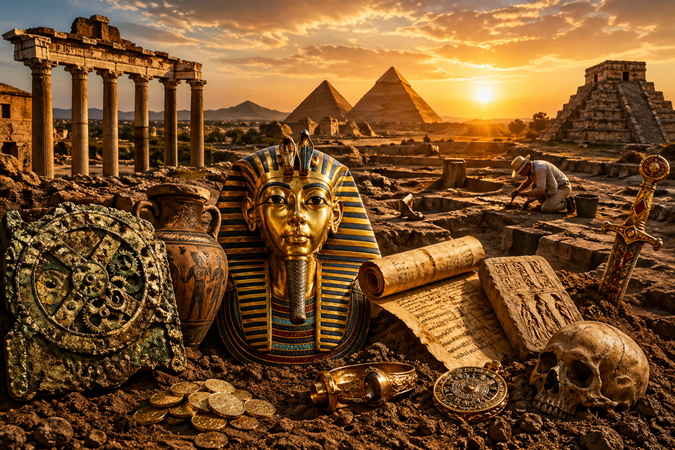

Across deserts buried beneath shifting sands, oceans hiding forgotten empires, and ancient cities sealed by volcanic fire, archaeology continues to reveal something extraordinary: the past is not just historically valuable—it is economically staggering.
Some discoveries are so rare, so perfectly preserved, and so historically significant that experts struggle to even estimate their worth. If measured purely in material terms, they would rival modern-day fortunes. Yet their true value goes far beyond money—they are irreplaceable fragments of human civilization, frozen in time.
From golden pharaohs to sunken imperial fleets, these discoveries represent the most expensive archaeological findings ever made or theoretically valued in human history.
When Archaeology Meets Immeasurable Wealth
Unlike modern commodities, archaeological discoveries cannot be priced easily. Most artifacts are protected under national heritage laws, meaning they are not legally sold or traded. However, experts still evaluate their theoretical worth based on several factors.
Material composition plays a role—gold, silver, gemstones, and rare metals naturally carry high value. But equally important is historical rarity. A single object tied to a lost civilization or unknown historical period can be worth more than tons of raw precious metal.
Even more important is cultural and academic significance. Some discoveries reshape entire historical timelines, forcing experts to rewrite what we thought we knew about ancient civilizations.
Because of this combination, certain archaeological discoveries are often described as being worth hundreds of millions or even billions of dollars, especially when entire collections or shipwrecks are considered together.
The Tomb of Tutankhamun – Egypt’s Eternal Golden Fortune

Few discoveries have ever matched the global impact of the tomb of Pharaoh Tutankhamun, discovered in 1922 in Egypt’s Valley of the Kings.
When archaeologist Howard Carter broke through the sealed chamber, he uncovered one of the most intact royal burial sites in history. Inside were over 5,000 artifacts, including golden chariots, ornate jewelry, ritual objects, statues, and the iconic solid gold death mask that has since become a symbol of ancient Egypt itself.
What makes this discovery extraordinary is not just its beauty, but its completeness. Unlike most royal tombs that were looted over centuries, Tutankhamun’s burial remained untouched for more than 3,000 years.
Modern experts suggest that if the collection were ever hypothetically valued in today’s economy, it could easily surpass several hundred million dollars, with some estimates placing its cultural and historical valuation close to or beyond $1 billion.
However, its real worth lies in the fact that it opened an entire window into ancient Egyptian royal life that would otherwise have been lost forever.
The Antikythera Mechanism – Technology Beyond Its Time

Discovered in a Roman-era shipwreck near the Greek island of Antikythera, this bronze device remains one of the most mysterious inventions ever uncovered.
Dating back over two millennia, the Antikythera Mechanism was designed to calculate astronomical positions, predict eclipses, and track planetary movements with astonishing precision. It is widely regarded as the world’s first analog computer.
Its importance is not material but intellectual. It proves that ancient civilizations possessed advanced scientific knowledge far earlier than previously believed.
If measured in terms of technological influence and modern research inspiration, the mechanism’s value could be considered virtually limitless—potentially worth billions in scientific advancement alone.
Even today, researchers are still decoding its complexity using modern imaging technology, and new discoveries about its function continue to emerge.
Pompeii – The Roman City Preserved in Ash and Time

When Mount Vesuvius erupted in 79 AD, it buried the Roman city of Pompeii in volcanic ash, sealing it in a state of eerie preservation.
Unlike typical archaeological sites, Pompeii is not a collection of fragments—it is an entire frozen city. Streets, homes, bakeries, temples, and bathhouses still stand almost exactly as they were nearly 2,000 years ago.
Excavations have revealed incredible luxury within elite Roman homes, including intricate frescoes, marble fountains, gold ornaments, and private spa rooms that reflect the sophistication of Roman society.
Because of its scale and completeness, Pompeii is considered one of the most valuable archaeological sites on Earth. If its artistic, architectural, and cultural assets were hypothetically monetized, its value would reach multi-billion-dollar cultural territory, though it remains strictly protected as a UNESCO World Heritage treasure.
Sutton Hoo – The Royal Ship Burial That Rewrote British History

In 1939, archaeologists in Suffolk, England uncovered one of the most important early medieval discoveries ever made: the Sutton Hoo ship burial.
Inside a massive burial mound lay a 27-meter-long ship filled with treasures belonging to an Anglo-Saxon ruler. Among the finds were a ceremonial iron helmet, gold and garnet-studded jewelry, silver bowls, and finely crafted weapons.
The craftsmanship of these objects suggests a highly developed and wealthy ruling elite during early medieval Britain—challenging earlier assumptions that the period was culturally primitive.
While the artifacts themselves are priceless, their historical importance in reshaping understanding of Britain’s early monarchy makes them one of Europe’s most significant archaeological discoveries.
The Black Sea Shipwrecks – Time Capsules Beneath the Ocean

Deep in the oxygen-free depths of the Black Sea, archaeologists have discovered ancient Greek and Byzantine shipwrecks preserved in extraordinary condition.
Some vessels are more than 2,000 years old, yet their wooden structures remain intact. Cargo such as amphorae, trade goods, and ship equipment has survived with remarkable detail.
Because preservation is so complete, each wreck offers unmatched insight into ancient maritime trade routes and naval engineering.
While individual shipwrecks could theoretically be valued in the tens of millions based on cargo and material, their true worth lies in the scientific knowledge they provide about ancient global trade systems.
The Terracotta Army – An Empire’s Underground Civilization

One of the most astonishing archaeological discoveries in history, the Terracotta Army was created to accompany China’s first emperor, Qin Shi Huang, into the afterlife.
Discovered in 1974 near Xi’an, the site contains more than 8,000 life-sized warriors, horses, and chariots, each uniquely sculpted with distinct facial features and armor.
The scale of construction suggests decades of labor involving thousands of workers. The artistic precision reflects an advanced level of organization and imperial power.
Although impossible to assign a real market value, the Terracotta Army’s global cultural significance places it among the most valuable archaeological discoveries in existence—potentially worth billions in heritage and tourism impact alone.
The Dead Sea Scrolls – Ancient Texts That Changed History

Hidden in caves near the Dead Sea, the discovery of the Dead Sea Scrolls in the mid-20th century revealed some of the oldest surviving biblical manuscripts ever found.
These texts include religious writings, community rules, and early versions of Hebrew scripture, dating back over 2,000 years.
Their importance lies in how they transformed biblical scholarship and deepened understanding of ancient religious traditions.
Because of their uniqueness, the scrolls are considered priceless. Their academic, religious, and historical significance makes them one of the most important manuscript discoveries in human history.
Spanish Treasure Galleons – Lost Billion-Dollar Shipwrecks

During the Age of Exploration, Spanish galleons carried vast quantities of gold, silver, and gemstones from the Americas back to Europe. Many of these ships were lost at sea due to storms, piracy, and naval warfare.
One of the most famous, the San José, is believed to contain treasure worth up to $17 billion in modern estimates.
These shipwrecks represent some of the largest lost fortunes in human history. However, legal disputes, preservation laws, and archaeological protections mean that most of these treasures remain untouched beneath the ocean floor.
The True Meaning of Archaeological Wealth
Although it is tempting to assign financial values to these discoveries, their real worth cannot be measured in currency alone.
Each discovery:
- Preserves a lost civilization
- Expands scientific understanding
- Rewrites historical narratives
- Connects modern humanity to its ancient origins
Once destroyed or lost, these artifacts can never be replaced. That makes them far more valuable than any modern asset.
Conclusion: The Infinite Wealth of the Ancient World
The most expensive archaeological discoveries ever made remind us that history itself is humanity’s greatest hidden fortune.
From golden Egyptian tombs and buried warrior armies to shipwrecks filled with imperial treasure, each discovery reveals that our planet still holds secrets beyond imagination.
And even today, with advanced satellite imaging and deep-sea exploration, archaeologists believe we have uncovered only a fraction of what still lies buried.
The greatest treasures of the world are not just beneath the earth—they are beneath time itself.
New Technology Perspective on Expensive Domain Names (Modern Digital Economy)
The value of the most expensive domain names ever sold is deeply tied to modern technological evolution. In today’s digital ecosystem, domain names are no longer just web addresses—they function as entry points into entire technological infrastructures. The rise of cloud computing, artificial intelligence, blockchain systems, and global SaaS platforms has significantly increased the importance of owning premium digital identifiers.
In the current technology landscape, domains act as central access layers for complex systems. Companies no longer rely solely on physical infrastructure; instead, they operate through distributed cloud servers, APIs, and automated digital ecosystems. A premium domain such as AI.com or Business.com becomes the “front door” to these systems, influencing branding, trust, and user engagement at scale.
Artificial intelligence has further transformed domain value. AI-driven platforms now analyze user behavior, optimize search rankings, and personalize digital experiences in real time. This means that domains are not only evaluated based on human perception but also on machine-driven discovery systems. Search engines, recommendation algorithms, and AI assistants all prioritize simple, authoritative, and high-trust domain names.
Additionally, blockchain technology and Web3 infrastructure are reshaping ownership models. Domains are increasingly being treated as decentralized digital assets that can be traded, tokenized, and secured using cryptographic systems. This shift is creating a new asset class where domains function similarly to financial instruments.
As digital transformation accelerates, industries such as e-commerce, fintech, and AI rely heavily on domain identity for global scalability. In this environment, a premium domain name is not just branding—it is a foundational layer of digital architecture that determines visibility, credibility, and long-term market dominance.
Ancient Civilizations Perspective on Domain Value (Historical Parallel of Digital Real Estate)
The extraordinary value of modern domain names can be better understood when compared to ancient civilizations, where control over names, locations, and trade routes determined economic and political power. In ancient Mesopotamia, Egypt, Rome, and the Indus Valley, cities that controlled trade hubs, rivers, and communication routes naturally became centers of wealth and influence.
In many ways, premium domain names function similarly to ancient “strategic locations.” Just as cities positioned along the Silk Road gained economic dominance due to trade flow, domains like Insurance.com or Cars.com dominate digital traffic because they occupy high-demand semantic positions in the online ecosystem.
In ancient societies, naming also held immense importance. A powerful name symbolized authority, identity, and legacy. Kings, empires, and dynasties invested heavily in establishing names that would last generations. Similarly, domain names today serve as digital identities for global brands, shaping perception and trust in milliseconds.
Trade in ancient civilizations was limited by geography, but the concept of value concentration was identical to today’s digital economy. Markets, ports, and city centers functioned as early “platforms” where goods, information, and influence converged. The internet has simply replaced physical proximity with digital accessibility.
Furthermore, scarcity played a major role in ancient wealth systems. Rare spices, metals, and trade goods were extremely valuable due to limited availability. Premium domain names follow the same principle—there is only one Cars.com, one Voice.com, and one AI.com. This scarcity creates exponential value.
Ultimately, the evolution from ancient trade civilizations to modern digital ecosystems shows a consistent pattern: control over central access points