





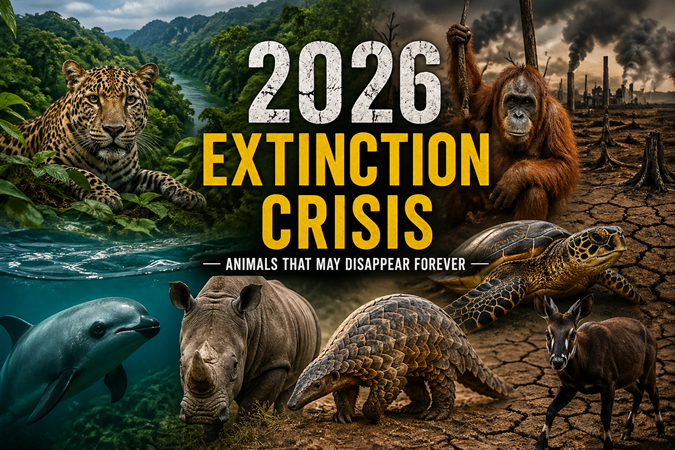
2026 Extinction Crisis: Animals That May Disappear Forever

The world is entering a dangerous phase in its environmental history. Every year, more species move closer to extinction, but 2026 is shaping up to be particularly alarming. Scientists and conservationists are no longer speaking in distant predictions — they are warning about species that may disappear within our lifetime, or even sooner.
Across forests, oceans, and remote ecosystems, animals that once thrived in abundance are now reduced to shockingly small populations. Some exist in isolated habitats, others are victims of illegal trade, and many are simply unable to adapt to the rapid changes humans have imposed on the planet.
According to global conservation data, thousands of species are now classified as critically endangered, facing an extremely high risk of extinction in the wild . What makes this moment more urgent is that many of these species are no longer declining slowly — they are collapsing at an accelerated pace.
This is not just a wildlife issue. It is a signal that ecosystems are becoming unstable, and when ecosystems fail, the consequences extend far beyond the natural world.
The Reality Behind Modern Extinction

Extinction is often thought of as a slow, natural process that unfolds over thousands of years. But what is happening today is very different. Human activity has dramatically sped up the rate at which species are disappearing.
Habitat destruction remains one of the biggest causes. Forests are cleared for agriculture, cities expand into natural landscapes, and water bodies are altered or polluted. At the same time, illegal wildlife trade continues to push already vulnerable animals closer to the edge. Climate change adds another layer of pressure, altering temperatures and weather patterns faster than many species can adapt.
Experts point out that habitat loss, poaching, and environmental changes are the primary drivers behind population decline worldwide . In many cases, these pressures do not act alone — they combine, creating a situation where survival becomes nearly impossible.
Some species now survive in such small numbers that even a single environmental shock could wipe them out completely. What follows is a closer, more detailed look at animals that may not survive beyond this critical decade.
1. Vaquita – The Most Endangered Marine Mammal on Earth

The vaquita, a small porpoise found only in Mexico’s Gulf of California, stands today as the rarest marine mammal in the world. With estimates suggesting fewer than ten individuals remaining, its survival is hanging by the thinnest thread.
The primary cause of its decline is not natural—it is human activity. Illegal gillnet fishing, used to catch totoaba fish, has unintentionally trapped and killed hundreds of vaquitas over the years. Despite international bans and conservation efforts, illegal fishing continues in parts of the region.
Conservationists fear that without immediate and strict enforcement, the vaquita may disappear completely within a very short period, possibly even in 2026.
2. Northern White Rhinoceros – A Species Already Functionally Gone

The northern white rhinoceros is one of the most tragic examples of human-driven extinction. Today, only two known individuals remain, both females, living under constant protection in Kenya.
This means natural reproduction is no longer possible. Scientists are attempting advanced reproductive technologies using preserved genetic material, but success is uncertain.
Once roaming across parts of Central and East Africa, this subspecies was wiped out primarily due to poaching for its horn, which is highly valued in illegal markets.
In biological terms, the northern white rhino is already functionally extinct, even if conservation science still holds a faint hope of revival.
3. Javan Rhinoceros – Living on a Single Fragile Island

The Javan rhinoceros is now restricted to a single protected area in Indonesia. With fewer than a hundred individuals remaining, the entire species depends on the stability of one national park.
This extreme concentration makes it highly vulnerable. Disease outbreaks, tsunamis, or habitat disruption could eliminate the entire population in one catastrophic event.
Although strict conservation laws have helped prevent poaching in recent years, the species remains critically endangered due to its extremely limited range and small population size.
4. Hainan Gibbon – The Rarest Primate on Earth

Once widespread across southern China, the Hainan gibbon has now been reduced to a tiny population living in a single forest reserve. With fewer than 50 individuals remaining, it is considered the rarest primate in the world.
Decades of deforestation and habitat fragmentation forced the species into isolated forest patches, making breeding extremely difficult.
Although conservation efforts have helped stabilize numbers slightly, its survival remains extremely fragile due to its limited genetic diversity and small habitat range.
5. African Forest Elephant – The Silent Loss of the Forest Giants

Unlike their savannah relatives, African forest elephants live deep inside tropical rainforests and are rarely seen. However, they are disappearing at alarming rates due to ivory poaching and habitat destruction.
These elephants play a crucial role in maintaining forest ecosystems by dispersing seeds across large distances. Their decline is not just a loss of an animal species but a disruption of entire forest systems.
If current trends continue, some populations may collapse entirely within the coming years.
6. Pangolin – The Most Trafficked Mammal in the World

Pangolins are small, nocturnal mammals covered in protective scales, but their defense has not saved them from human exploitation. They are heavily trafficked across Asia and Africa for their scales and meat.
Despite international protection laws, illegal trade networks continue to operate, making pangolins one of the most illegally traded mammals on Earth.
Their population decline is so severe that some species are now considered critically endangered and at risk of disappearing entirely in the near future.
7. Saola – The Mysterious “Asian Unicorn”

The saola is one of the most elusive mammals ever discovered. Found only in the Annamite Mountains between Vietnam and Laos, it is so rarely seen that scientists know very little about its population size or behavior.
Often called the “Asian unicorn,” the saola is threatened primarily by illegal hunting traps set for other animals. Even though it is not directly targeted, it often becomes accidental victims of snares.
With no confirmed captive population, its survival remains uncertain.
8. Axolotl – The Species That Lives Forever… Except in the Wild

The axolotl is widely known for its ability to regenerate limbs and its almost “immortal” appearance in captivity. However, in the wild, it tells a very different story.
Native to the lakes of Mexico, wild axolotl populations have declined drastically due to water pollution, urban expansion, and invasive species.
Ironically, while millions are kept in laboratories and aquariums around the world, the wild axolotl population is now critically endangered and may disappear entirely from its natural habitat.
Species Standing on the Brink in 2026

One of the most alarming examples is the vaquita, a small marine mammal found in Mexico’s Gulf of California. With fewer than ten individuals remaining, it is now considered the rarest marine mammal on Earth. Its decline has been driven almost entirely by illegal fishing nets, which continue to threaten its survival despite global attention.
Equally heartbreaking is the story of the northern white rhinoceros. Only two females remain alive today, making natural reproduction impossible. Scientists are attempting to use advanced reproductive technologies, but without success, this species may soon exist only in history books.
The Javan rhinoceros faces a different but equally dangerous situation. Its entire population lives within a single national park in Indonesia. While protection efforts have helped prevent poaching, the species remains highly vulnerable. A single natural disaster could wipe out the entire population in one catastrophic event.
In China, the Hainan gibbon has become the rarest primate in the world. Once widespread, it now survives in a single forest reserve, with only a few dozen individuals left. Habitat destruction has pushed it to the brink, and its slow reproduction rate makes recovery extremely difficult.
The Amur leopard, known for its striking beauty, is another species fighting for survival. With around a hundred individuals remaining in the wild, conservation efforts have provided some hope, but threats such as poaching and habitat fragmentation continue to limit its recovery.
Lesser-Known Species Facing Silent Extinction

While large mammals often receive global attention, many lesser-known species are disappearing quietly.
The pangolin, for instance, is the most trafficked animal in the world. Its scales are highly valued in illegal markets, leading to widespread poaching. Despite international bans, the demand has not slowed, pushing the species closer to extinction.
In aquatic ecosystems, the European eel has seen dramatic population declines. Overfishing, pollution, and habitat disruption have contributed to a massive drop in its numbers, with some regions experiencing declines of over 90 percent .
Even unusual and recently discovered species, such as rare reptiles and amphibians, are now at risk. Many of them exist only in small geographic areas, making them extremely vulnerable to environmental changes and human interference.
Why These Extinctions Matter More Than Ever

The disappearance of a single species may not seem significant at first glance, but in reality, every species plays a role in maintaining ecological balance.
When one species disappears, it can trigger a chain reaction. Predators lose their prey, plants lose pollinators, and entire ecosystems begin to shift. Over time, this can lead to what scientists call “extinction cascades,” where multiple species vanish as a result of one initial loss.
There is also a direct impact on human life. Ecosystems provide essential services such as clean air, water, food production, and climate regulation. As biodiversity declines, these systems become less stable and less reliable.
Studies suggest that extinction rates today are far higher than natural levels, with hundreds of species already lost in recent decades and many more at risk . This trend indicates that we may be entering a period of mass extinction driven largely by human activity.
Is There Still Hope for These Species?

Despite the severity of the situation, there are reasons to remain cautiously optimistic. Conservation efforts around the world have shown that recovery is possible when action is taken in time.
Recent success stories demonstrate this clearly. Some species that were once on the brink have been brought back through dedicated conservation programs, habitat restoration, and scientific intervention. These efforts prove that extinction is not always inevitable.
However, the window for action is rapidly closing. For many species listed as critically endangered, the next few years will determine whether they survive or disappear forever.
A Final Reflection

The animals that could go extinct in 2026 are not just names on a list. They represent the fragile state of our planet and the consequences of decades of environmental neglect.
What makes this moment different is the urgency. Unlike in the past, we now have the knowledge and resources to prevent many of these extinctions. The question is whether we are willing to act quickly enough.
If current trends continue, future generations may only know these species through photographs and documentaries. But if meaningful action is taken now, there is still a chance to change the outcome.
The fate of these animals is not sealed yet — but it is dangerously close.
Extinction Event
An extinction event refers to a widespread and rapid decrease in the biodiversity of life on Earth, where a significant number of species disappear in a relatively short geological period. These events are not normal background extinctions that happen gradually over time; instead, they are catastrophic in scale and often reshape the entire ecosystem of the planet.
Throughout Earth’s history, scientists have identified five major extinction events, often called the “Big Five.” One of the most well-known is the event that wiped out the dinosaurs around 66 million years ago, believed to have been caused by a massive asteroid impact combined with dramatic climate shifts. Other extinction events have been linked to volcanic eruptions, ocean acidification, and extreme global temperature changes.
What makes extinction events so important is their ability to reset life on Earth. When dominant species disappear, it opens ecological space for new life forms to evolve. For example, after the extinction of dinosaurs, mammals gradually rose to dominance, eventually leading to the evolution of humans.
In modern discussions, scientists also warn about the possibility of a “sixth extinction event.” Unlike past events caused by natural disasters, this one is largely driven by human activity. Habitat destruction, pollution, climate change, overfishing, and deforestation are accelerating species loss at a rate much faster than natural background levels.
The concern is not just about individual species disappearing but about the collapse of entire ecosystems. Since all life is interconnected, the loss of one species can trigger a chain reaction affecting food chains, climate balance, and even human survival.
Understanding extinction events helps us recognize how fragile life on Earth truly is and why conservation efforts are essential for maintaining ecological balance.
Human Extinction
Human extinction refers to a hypothetical scenario in which the entire human species ceases to exist. While it is not an immediate reality, scientists, philosophers, and futurists study it to understand long-term risks that could threaten our survival as a species.
There are many potential causes of human extinction, ranging from natural disasters to human-made threats. Natural risks include large asteroid impacts, supervolcanic eruptions, and extreme climate changes that could make Earth uninhabitable. However, modern concerns focus more on human-driven dangers such as nuclear war, global pandemics, artificial intelligence misuse, and irreversible environmental collapse.
One of the most discussed threats is climate change. If global temperatures rise beyond manageable levels, it could lead to food shortages, mass migration, and ecosystem collapse, creating conditions too harsh for human survival. Similarly, a large-scale nuclear conflict could trigger a “nuclear winter,” blocking sunlight and disrupting agriculture worldwide.
Another emerging concern is advanced artificial intelligence. While AI has enormous benefits, uncontrolled development without proper safeguards could lead to unintended consequences that threaten human control over critical systems.
Despite these risks, human extinction is not considered inevitable. Humanity has survived ice ages, diseases, and numerous global crises in the past. What makes the current era different is the scale and speed of technological and environmental change.
The study of human extinction is not meant to create fear but awareness. It encourages global cooperation, sustainable development, and responsible innovation. By understanding these risks early, societies can take preventive measures such as climate action, peacebuilding, and ethical technology development.