






Jackpot to Bankruptcy: Shocking Stories of Lottery Winners Who Went Broke
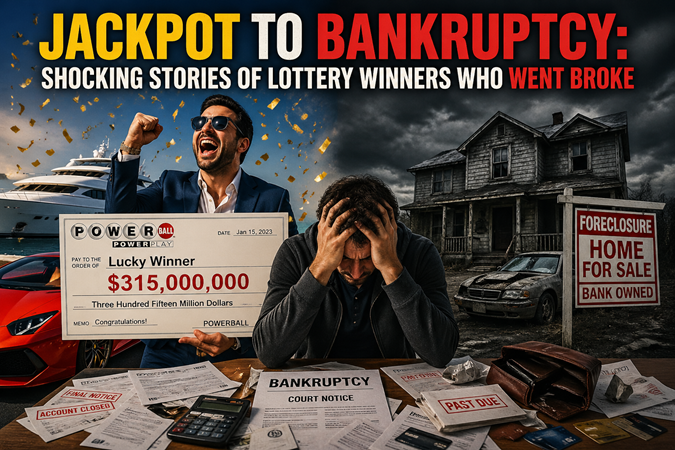

There is a moment every lottery winner remembers, even years later. It is not the celebration, not the champagne, not the calls from family. It is the first quiet second when they realize the numbers are real and their life has permanently split into “before” and “after.”
For a brief period, everything feels suspended in possibility. Problems that once felt heavy suddenly feel distant. Rent, debt, work, and uncertainty appear to dissolve overnight. It feels like survival has finally been replaced by freedom. But what happens next is where the story stops being a fantasy and starts becoming a pattern.
Across countries and decades, lottery winners have repeatedly followed the same trajectory. The details change, but the structure does not. Wealth arrives suddenly, behavior adjusts slowly, and reality catches up faster than expected. Many end up losing everything they once believed would last forever. This is not a rare tragedy. It is a repeatable outcome shaped by psychology, environment, and the simple fact that human beings are not designed to absorb sudden financial transformation without friction.
When life changes overnight but the mind doesn’t
To understand why lottery winners fail, it is important to understand what actually changes when someone wins. The bank balance changes instantly. The lifestyle can change instantly. But the mind does not. Most winners are still operating with the same internal framework they used when they were living paycheck to paycheck. Their decisions are still shaped by scarcity thinking, emotional reactions, and social pressure. Suddenly, however, those same decisions are being made at a completely different scale.
A small favor becomes a large financial commitment. A modest upgrade becomes a lifestyle system. A temporary celebration becomes a permanent expense structure. The problem is not just spending. It is the inability to recognize that wealth is not a static number. It is a system that requires maintenance. This gap between old thinking and new reality is where most stories begin to collapse.
Michael Carroll and the speed at which wealth disappears

One of the most widely referenced cases in modern lottery history is Michael Carroll, a UK lottery winner who received approximately £9.7 million at just 19 years old. For someone living a working-class life in England, it was a transformation beyond imagination. Within a very short time, he went from a rented life to owning a mansion, expensive vehicles, and a lifestyle built entirely around consumption.
At first, it looked like freedom. But there was no structure behind it. No financial planning, no boundaries, no gradual transition into wealth management. Money became a tool for immediate gratification rather than long-term stability. Large sums were spent on parties, luxury goods, and social circles that expanded rapidly around him. Money was also distributed to friends and family early on, often without sustainable planning.
Within a few years, the money was gone. By 2010, he was bankrupt. What makes his story so important is not just the outcome, but the speed. It demonstrates that wealth does not disappear slowly when unmanaged—it accelerates the lifestyle that consumes it.
Bud Post and the collapse of relationships under money pressure

Another widely cited case is William “Bud” Post, who won $16.2 million in 1988. At first, it appeared to be a life-changing rescue from financial struggle. But almost immediately, complications began to emerge. Instead of stability, the money triggered conflict.
Within a short time, he was facing debt despite the win. Legal disputes arose, including lawsuits from individuals close to him. Family tensions escalated. Business decisions failed under pressure. Even threats and violent tension reportedly became part of his environment. Eventually, he filed for bankruptcy.
His reflection later in life was simple but powerful: the money did not bring peace—it amplified instability that was already present. His story reveals a crucial truth that often gets overlooked. Money does not operate in isolation. It changes how other people behave toward the winner. It reshapes relationships, expectations, and emotional boundaries. And those changes are often more destructive than spending itself.
Janite Lee and the quiet failure of generosity

Not all lottery failures are driven by excess or addiction. Some are driven by something far more socially acceptable: generosity. Janite Lee won around $18 million and initially appeared to manage her wealth responsibly. She donated to universities, supported political causes, contributed to charities, and helped family members. Her life became socially active, visible, and respected.
But generosity, when not structured, becomes a financial drain without limits. Over time, she made the decision to sell her future annuity payments in exchange for a lump sum, trading long-term stability for immediate liquidity. Combined with ongoing spending and obligations, her wealth eroded faster than expected. Eventually, she filed for bankruptcy with almost no remaining assets.
Her story is particularly important because it challenges a common assumption: that good intentions protect financial outcomes. In reality, even positive spending can become destructive without boundaries. Money does not distinguish between generosity and excess. It only measures outflow.
Evelyn Adams and the psychology of repetition

There are also cases where the failure is not immediate consumption but behavioral repetition. Evelyn Adams famously won the lottery twice, earning millions in total. Statistically, this alone is extraordinary. But even after repeated success, she continued engaging in lottery play and gambling behavior.
Over time, her winnings disappeared. Her case highlights a less discussed factor: winning does not automatically change underlying psychological habits. If the behavior that created risk remains unchanged, even large financial gains become temporary. We often assume wealth fixes behavior. In reality, behavior determines how long wealth survives.
The real reason lottery winners lose everything

When all these cases are viewed together, a clear structure emerges. It is not random. It is not moral failure. It is not simply bad decisions. It is a predictable sequence. Sudden wealth arrives faster than identity can adapt. Lifestyle expands faster than income structure can support. Social pressure grows faster than boundaries can control. Spending decisions begin to reflect emotion rather than planning.
The money itself is not the problem. The absence of systems is. A lottery win is not just a financial event. It is a psychological stress test delivered instantly, without preparation.
Why some winners survive while others collapse
Interestingly, not every winner loses everything. Some manage to preserve their wealth for decades. The difference is rarely intelligence. It is structure. Survivors tend to slow down. They delay decisions. They build systems before changing lifestyle. They protect privacy and avoid lifestyle inflation. Most importantly, they do not treat money as identity transformation. They treat it as responsibility.
Survival is usually unglamorous. It is restraint, not excitement. It is boring structure, not emotional spending.
The pattern that repeats across every country and decade
From the UK to the United States, from the 1980s to the modern era, the same story repeats itself with minor variations. A person wins life-changing money. Life changes too quickly. Behavior lags behind reality. Pressure builds from every direction. Eventually, the system collapses under its own weight.
The lottery does not create new personalities. It reveals existing ones under amplified conditions. That is why these stories never feel like exceptions once you see enough of them. They feel like variations of the same underlying structure.
Conclusion: wealth does not fail—unprepared systems do
The most important lesson from all these stories is not that sudden wealth is dangerous. It is that unstructured wealth is fragile. Money on its own does not guarantee stability, happiness, or security. It only expands whatever system already exists around it. If that system is unprepared for scale, the result is often collapse.
Lottery winners do not lose everything because they are uniquely careless. They lose everything because they are suddenly asked to manage something they were never trained to handle. And in that gap between fortune and structure, the real story of sudden wealth is always written.
Lottery Winners Who Lost Everything
There is a powerful illusion attached to the idea of winning the lottery. It suggests permanence. Once someone becomes rich overnight, the assumption is that life has been permanently upgraded. But history repeatedly shows the opposite. Many lottery winners eventually return to financial struggle, sometimes even worse off than before.
The reason for this recurring pattern lies in how sudden wealth interacts with human behavior. Most winners are not financially trained to handle large capital. They are used to managing limited monthly income, where every expense is calculated around survival. When millions suddenly enter their lives, the decision-making framework does not evolve at the same speed.
Instead of transitioning into structured wealth management, many winners begin expanding their lifestyle immediately. Houses are upgraded, cars are purchased, family obligations increase, and social expectations multiply. The problem is that these expenses are not one-time events—they are recurring financial commitments that permanently increase monthly pressure.
Another major factor is psychological identity shock. People who have lived in financial scarcity often experience sudden wealth as emotional relief rather than capital responsibility. This leads to impulsive decisions, generosity without limits, and spending driven by emotion rather than planning.
Social environment also plays a major role. Friends, relatives, and acquaintances often begin requesting financial support, either directly or indirectly. Winners find themselves in a position where saying “no” feels emotionally difficult, which gradually erodes their capital base.
Over time, even large fortunes begin to shrink. Not through one catastrophic event, but through continuous small financial decisions that were never structured for long-term sustainability. Eventually, many winners face bankruptcy, debt, or a return to normal financial life.
The most important insight is that lottery wealth does not fail suddenly. It fails gradually through lifestyle expansion, emotional decision-making, and lack of structural financial discipline.
Tragic Stories of Lottery Winners
Behind every lottery jackpot lies a story that often begins with joy but sometimes ends in emotional and personal tragedy. These stories are not just about money loss—they are about how sudden wealth reshapes identity, relationships, and emotional stability in unexpected ways.
One of the most overlooked consequences of lottery winnings is the psychological pressure that follows. Winners suddenly become central figures in their social circles. Family members, friends, and even distant acquaintances begin to view them differently. What was once a normal relationship becomes financially charged, often leading to guilt-based decisions and emotional stress.
In many tragic cases, winners report feeling isolated despite being surrounded by people. The presence of money changes trust dynamics. Some relationships become transactional, while others collapse entirely due to jealousy or expectation mismatch. This emotional instability often leads to poor financial decisions made not out of logic, but out of emotional exhaustion.
Another recurring element in tragic lottery stories is loss of personal identity. Many winners struggle to adjust to their new role as “wealthy individuals.” They feel pressure to perform success through visible spending—luxury homes, expensive cars, and public displays of wealth. Over time, this performance becomes financially unsustainable, but emotionally difficult to stop.
There are also cases where sudden wealth amplifies pre-existing vulnerabilities. Issues like addiction, impulsive behavior, or poor financial habits do not disappear with money. Instead, they become more destructive because they are now powered by larger resources.
Some of the most tragic stories also involve legal disputes, family conflicts, and emotional breakdowns that arise after the win. Wealth becomes the center of tension, turning relationships into pressure systems instead of support systems.
Ultimately, these stories reveal a deeper truth: lottery winnings do not guarantee happiness or stability. In fact, without emotional structure, boundaries, and financial discipline, sudden wealth can intensify instability rather than eliminate it.