






$30 Million on Your Wrist: Top 10 Most Expensive Watches Ever Sold in History
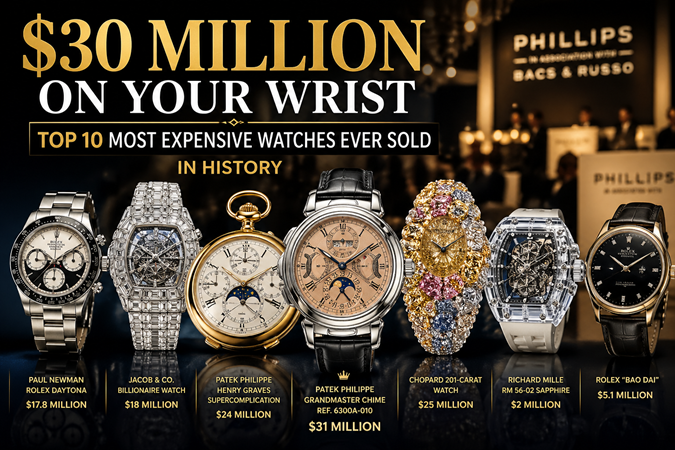

Luxury watches occupy a rare space in the modern world—where engineering precision, artistic craftsmanship, and financial power converge into a single object worn on the wrist. While most watches are purchased for utility or style, the rarest timepieces exist in an entirely different universe. They are bought at auction houses, fought over by billionaires, and preserved as long-term assets comparable to fine art.
Over the last two decades, the global watch auction market has transformed dramatically. Once a niche collector’s space, it has evolved into a multi-billion-dollar industry driven by scarcity, provenance, and the rise of ultra-high-net-worth individuals across the world. Prestigious auction houses such as Christie’s, Sotheby’s, and Phillips now regularly host sales where a single watch can command tens of millions of dollars, rewriting records and redefining luxury itself.
What follows is not just a list of expensive watches, but a detailed exploration of the most valuable timepieces ever sold, and the deeper reasons behind their extraordinary worth.
1. Patek Philippe Grandmaster Chime 6300A-010 – The $31 Million Benchmark

At the very top of the auction world stands a watch that has become synonymous with ultimate horological achievement. The Patek Philippe Grandmaster Chime 6300A-010, sold for over $31 million, is widely regarded as the most expensive wristwatch ever auctioned.
What sets this watch apart is not just its price, but its engineering ambition. It contains twenty complications—features that go far beyond simple timekeeping. These include a perpetual calendar that automatically adjusts for leap years, a minute repeater that chimes the time acoustically, and dual time-zone displays. Even more impressive is its reversible case, allowing the wearer to switch between two entirely different dials.
However, the defining factor behind its record-breaking price is its uniqueness. This particular model was created as a one-off piece for a charity auction, making it literally irreplaceable. In a market where scarcity drives value, this watch represents the purest form of exclusivity—an object that cannot be replicated, reissued, or reproduced.
2. Graff Diamonds Hallucination Watch – When Jewelry Surpasses Horology

While most record-breaking watches derive value from mechanical complexity, the Graff Diamonds Hallucination takes an entirely different approach. Valued at around $55 million, it is considered the most expensive watch ever created, though not sold in a traditional auction.
This piece is less about timekeeping and more about the art of gemstones. It features over 110 carats of rare colored diamonds, carefully selected and arranged to create a kaleidoscope of color. Pink, blue, green, and yellow diamonds are set with extraordinary precision, transforming the watch into a wearable masterpiece.
Its significance lies in how it challenges traditional definitions of luxury watches. Instead of mechanical innovation, it focuses on rarity at the atomic level—the geological uniqueness of diamonds formed over millions of years. In doing so, it represents a parallel path in luxury collecting, where jewelry craftsmanship rivals traditional horology.
3. Graff Diamonds Fascination Watch – A Transformable Icon of Modern Luxury

The Graff Diamonds Fascination watch continues this theme of redefining what a watch can be. With an estimated value between $40 million and $50 million, it introduces a concept rarely seen in high-end timepieces—transformation.
At the center of the watch is a 38-carat pear-shaped diamond that can be detached and worn as a ring. This dual-function design reflects a growing trend among ultra-wealthy collectors, who increasingly seek versatility even in the most extravagant objects.
Beyond its visual brilliance, the watch represents a shift in luxury philosophy. It is no longer enough for an item to be rare—it must also adapt to multiple identities, functioning as both jewelry and timepiece. This evolution mirrors broader changes in luxury consumption, where flexibility and personalization are becoming just as valuable as exclusivity.
4. Breguet Marie Antoinette Pocket Watch – A Survivor of History

Few objects in the world carry as much historical depth as the Breguet Marie Antoinette pocket watch. Commissioned in the 18th century and associated with Queen Marie Antoinette, this watch is often described as the most ambitious horological project of its time.
Its construction spanned more than four decades, involving multiple generations of watchmakers. By the time it was completed, both its original patron and its creator had passed away, adding a layer of historical poignancy to its existence.
Technically, the watch was designed to include every known complication of its era, making it a benchmark of mechanical ingenuity. But its true value lies in its narrative—it has survived revolutions, theft, and restoration, emerging as a living artifact of European history.In many ways, it represents the idea that the most valuable watches are not just built—they endure.
5. Patek Philippe Henry Graves Supercomplication – The Peak of Mechanical Ambition

Before the era of digital tools and computer-aided design, creating a highly complex watch required extraordinary human skill. The Henry Graves Supercomplication is perhaps the greatest example of this craftsmanship.
Commissioned by American banker Henry Graves Jr. in the early 20th century, this pocket watch features 24 complications, including celestial charts that map the night sky as seen from New York City. Every component was crafted by hand, with no technological assistance.
When it sold for approximately $24 million, it was not just a reflection of rarity—it was recognition of a lost era of craftsmanship, where human ingenuity alone pushed the boundaries of what was mechanically possible.
6. Chopard 201 Carat Watch – The Dominance of Gemstone Luxury

The Chopard 201-Carat Watch represents the intersection of fine jewelry and horology at its most extravagant level. With a value of around $25 million, it is composed almost entirely of diamonds, including three rare center stones in pink, blue, and white.
Unlike traditional watches that emphasize mechanical movement, this piece focuses entirely on visual impact. It is designed to captivate, to dazzle, and to communicate wealth instantly.
Its existence highlights an important truth about the luxury market: value is not always tied to function. Sometimes, it is defined purely by rarity, beauty, and the emotional response it evokes.
7. Jacob & Co Billionaire Watch – The Rise of Modern Statement Pieces

The Jacob & Co Billionaire Watch reflects a new era in luxury culture—one that embraces boldness and visibility. Valued at approximately $18 million, it is covered entirely in emerald-cut diamonds and features a skeletonized movement that reveals its inner workings.
This watch is not subtle. It is designed to be seen, recognized, and admired. Its popularity among celebrities and athletes signals a shift in how luxury is expressed, moving away from understated elegance toward high-impact visual statements.
In many ways, it represents the modern collector’s mindset: luxury as identity, not just possession.
8. Rolex Daytona Paul Newman – The Power of Provenance

The Rolex Daytona once owned by Paul Newman is a perfect example of how storytelling can transform an object’s value. Originally just a racing chronograph, it became a global icon after being associated with the legendary actor.
When it sold for over $17.7 million, it demonstrated that emotional and cultural significance can outweigh even the finest materials. Collectors were not just buying a watch—they were buying a piece of Hollywood history.
This phenomenon, known as provenance, is one of the most powerful drivers of value in the auction world.
9. Patek Philippe 1518 – The Birth of Modern Complications

The Patek Philippe Ref. 1518 is widely regarded as one of the most important watches ever made. Introduced in the 1940s, it was the first wristwatch to combine a perpetual calendar with a chronograph in serial production.
A rare stainless-steel version sold for over $17 million, largely because of its extreme scarcity and historical importance. It represents a turning point in watchmaking, where complex functions became wearable on the wrist.
For collectors, owning this watch is like owning the foundation of modern horology.
The Economics of Time: Why Watch Prices Keep Rising
The rapid increase in watch prices over the last decade is not accidental. It reflects broader economic and cultural shifts in the global luxury market. As wealth continues to concentrate among high-net-worth individuals, demand for rare, tangible assets has increased dramatically.
Watches, in particular, offer a unique combination of portability, durability, and emotional value. Unlike real estate or fine art, they can be worn, displayed, and transported with ease. This makes them highly attractive as alternative investments.
Additionally, brands like Patek Philippe and Rolex have intentionally limited production, creating artificial scarcity that drives up demand. Combined with the influence of social media, celebrity endorsements, and global auction exposure, this has created a perfect environment for price escalation.
Industry experts now believe that the next record-breaking watch sale could exceed $50 million, especially if a unique, historically significant piece enters the market.
Most Expensive Watch Brands in the World (Extended Insight)
When we talk about the most expensive watches ever sold, it’s impossible to ignore the brands behind these masterpieces. Names like Patek Philippe, Rolex, Richard Mille, Audemars Piguet, and Vacheron Constantin are not just brands—they are institutions of craftsmanship, heritage, and innovation.
At the pinnacle sits Patek Philippe, widely regarded as the king of haute horology. The brand’s philosophy revolves around creating watches that can be passed down through generations. Their timepieces often feature highly complicated movements such as perpetual calendars and minute repeaters, which require years of expertise to perfect. This dedication to craftsmanship is one of the main reasons why Patek Philippe dominates auction records.
Rolex, on the other hand, represents a different kind of luxury—one rooted in durability, precision, and iconic design. While Rolex produces watches at a larger scale compared to Patek Philippe, rare vintage models like the Daytona have reached staggering prices due to their cultural significance and scarcity.
Then comes Richard Mille, a relatively modern brand that has disrupted the industry with futuristic designs and cutting-edge materials like sapphire crystal and carbon composites. Unlike traditional brands, Richard Mille focuses on innovation and exclusivity, often producing extremely limited pieces that appeal to elite collectors and athletes.
Audemars Piguet and Vacheron Constantin complete the circle of ultra-luxury watchmaking. These brands are known for their artistic finishing, skeletonized designs, and centuries-old heritage. In today’s collector market, owning a watch from any of these brands is not just about style—it is about status, legacy, and investment potential.
In 2025–2026, these brands continue to dominate auctions and private sales, proving that true luxury lies in timeless craftsmanship rather than fleeting trends.
The Most Expensive Watch Ever Sold (Deep Dive)
Patek Philippe Grandmaster Chime Ref. 6300A-010 holds the undisputed title of the most expensive watch ever sold, fetching an astonishing 31 million USD at auction. But the price alone doesn’t fully capture its significance. This watch represents the absolute peak of human ingenuity in watchmaking.
What makes the Grandmaster Chime so extraordinary is its complexity. It features twenty complications, including a minute repeater, perpetual calendar, and even a unique alarm that chimes the date. Each of these functions requires intricate mechanical engineering, and combining them into a single watch is an achievement that only a handful of watchmakers in the world can accomplish.
The watch also features a reversible case with two dials, allowing the wearer to switch between displays. This dual-faced design adds both functionality and visual intrigue, making it unlike any conventional wristwatch.
Perhaps the most fascinating aspect of this timepiece is its exclusivity. The stainless steel version sold at auction is the only one of its kind, making it a true one-of-one creation. In the world of luxury collecting, rarity is everything, and this watch represents the ultimate expression of that principle.
Its sale also highlights the growing trend of watches as investment assets. Collectors are no longer just buying watches to wear; they are acquiring them as long-term stores of value, similar to fine art or rare collectibles.
Ultimately, the Grandmaster Chime is more than just a watch. It is a symbol of what happens when craftsmanship, innovation, and exclusivity come together to create something truly timeless.