




Top 10 Resume Mistakes That Get You Rejected in 2026
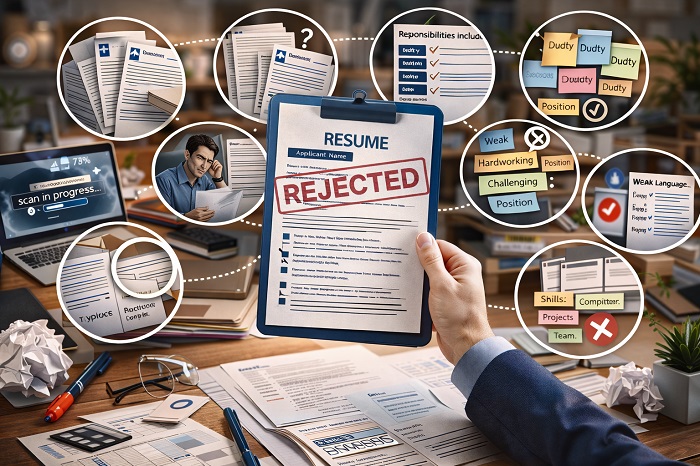

In 2026, most resumes do not get rejected because the candidate is completely unqualified. They get rejected because the resume fails to communicate fit, value, or clarity fast enough. Recruiters still scan quickly, and ATS filters still matter, which means a resume has to work for both software and humans. Current guidance from Indeed, Coursera, and Jobscan continues to emphasize tailoring, measurable achievements, clean formatting, and ATS friendly structure as core factors in whether a resume gets noticed or ignored.
The good news is that most resume mistakes are fixable. They are not mysterious. They usually come down to relevance, readability, and proof. If your resume is getting ghosted, one or more of the mistakes below may be the reason.
1. Using the same resume for every job
One of the biggest mistakes is sending the exact same resume to every opening. Indeed’s resume guidance says tailoring your resume to the job description helps show employers how your qualifications align with the role, and it specifically highlights the benefits of customization. A generic resume often looks unfocused, even when the candidate is strong.
The fix is to adapt your headline, summary, skills, and experience bullets to the role you are applying for. That does not mean inventing new experience. It means highlighting the most relevant parts first. A resume for a content role should not look identical to one for operations or customer success.
2. Writing duties instead of achievements
A resume that only lists responsibilities sounds flat. Coursera’s resume advice says measurable impact helps candidates stand out, and Indeed’s guidance on accomplishments recommends showing what you achieved using your skills rather than simply describing what you were responsible for. Recruiters want evidence of contribution, not a job description copied into bullet points.
The fix is to turn passive duty statements into result focused bullets. Instead of writing “Responsible for social media posts,” write something like “Managed social content calendar that increased average engagement by 28 percent in three months.” Numbers are not mandatory in every line, but proof matters.
3. Ignoring ATS friendly formatting
A lot of candidates still use fancy resume layouts that look polished but parse poorly. Jobscan’s current ATS guidance says tables, columns, and graphics are not reliably read by ATS systems, and it specifically warns against putting critical information in headers or footers. That means a visually impressive resume can still fail before a recruiter ever sees it.
The fix is to keep the format simple and readable. Use a single column layout, standard section headings, and clean fonts. Save it in the file format requested by the employer, and avoid design elements that interfere with parsing.
4. Not matching keywords from the job description
If the job description repeatedly mentions tools, skills, or functions that are missing from your resume, your application may rank lower in screening. Jobscan recommends matching resume keywords to the skills found in the job description, and Indeed also advises aligning your resume with job specific language.
The fix is to study the posting before you apply. Identify repeated terms such as CRM, stakeholder management, SQL, campaign reporting, payroll, reconciliation, or curriculum design. Then include the ones you genuinely have in the relevant sections of your resume. Keyword matching should be truthful, not forced.
5. Making the resume too long or too dense
Many resumes are rejected simply because they are exhausting to read. LinkedIn’s current summary of resume mistakes points to excessive length, dense text blocks, and clutter as common issues that hurt interview chances. If a recruiter cannot quickly understand your profile, your chances fall.
The fix is to cut aggressively. Prioritize recent and relevant experience, shorten older roles, and break information into clean bullets. Your goal is not to document your entire life. Your goal is to make the most relevant value obvious within seconds.
6. Including irrelevant or outdated information
Old school resume habits still hurt candidates. LinkedIn’s resume guidance flags unnecessary personal details, outdated email addresses, irrelevant hobbies, and old information that adds no hiring value. The more space wasted on low value content, the less room you have for what matters.
The fix is to remove anything that does not support your candidacy. In most cases, that means no full home address, no unrelated school level details if you already have a degree, no random hobbies unless they strengthen your fit, and no experience from fifteen years ago unless it is still relevant.
7. Poor proofreading
Spelling, grammar, and formatting mistakes still create instant doubt. Indeed’s resume writing guidance specifically includes proofreading tips, and LinkedIn’s summary of damaging mistakes also calls out spelling and grammar errors as major problems. A sloppy resume suggests sloppy work.
The fix is not just using spell check once. Read the resume aloud, check date consistency, confirm job titles, and ask another person to review it. One typo may not always kill an application, but multiple errors absolutely can.
8. Using weak summaries and vague language
Many resumes open with generic statements like “hardworking professional seeking a challenging role.” That says almost nothing. Coursera and Indeed both emphasize clarity, relevance, and a strong first impression. If your opening section is vague, the rest of the resume starts from a weaker position.
The fix is to write a short summary that is specific to your role, level, and value. For example, “Digital marketer with 3 years of experience in performance campaigns, reporting, and content strategy for B2B SaaS brands” is far more useful than a generic objective.
9. Leaving out projects, certifications, or proof of skill
For freshers, career switchers, and early career candidates, a lack of proof can be a major problem. Indeed’s simple resume guidance says standout projects, internships, and certifications can strengthen an application, especially when they demonstrate relevant skills.
The fix is to include real proof of capability. If you do not have much formal experience, show projects, internships, freelance work, certifications, case studies, or portfolio links where appropriate. Employers are more open to nontraditional evidence than many candidates assume.
10. Failing to make the resume easy to scan
Even a qualified candidate can get rejected if the resume hides the important parts. Indeed’s guidance on what a good resume looks like and how to write one employers notice both emphasize organization, readability, and showing value clearly. Recruiters should not have to work to understand who you are.
The fix is to lead with the strongest information. Put the most relevant experience high on the page, use clean section labels, keep bullets concise, and make achievements visually easy to find. A resume should feel obvious, not clever.
Conclusion
The top resume mistakes in 2026 are not about tiny secrets or hacks. They are mostly about failing on basics that still matter: tailoring, proof, clarity, and ATS compatibility. Indeed, Coursera, and Jobscan all point in the same direction. Strong resumes are relevant to the role, easy to scan, simple in format, and filled with concrete evidence of value.
If your resume is not getting responses, do not assume you need more qualifications immediately. First, make sure your existing qualifications are being presented in a way employers and ATS systems can actually understand.