





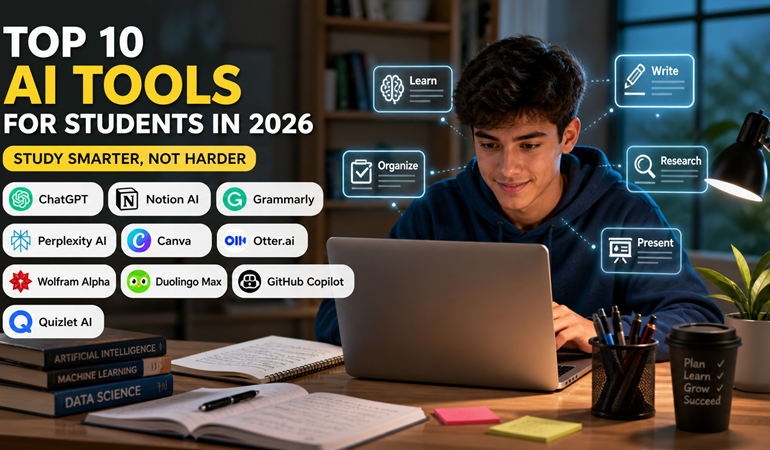
Top 10 AI Tools for Students in 2026 (Free & Paid): The Ultimate Productivity Stack

The Real Problem With Studying Today
It’s not that students aren’t putting in effort. In fact, most students today are overwhelmed rather than lazy. Long lectures, dense textbooks, endless assignments—it’s easy to spend hours studying and still feel like nothing is sticking.
What makes this more frustrating is that research consistently shows students don’t actually study as much as expected—often just a couple of hours a day. Yet they’re still required to perform at a high academic level.
So what’s going wrong?
The answer is simple: inefficient study methods.
Traditional studying involves a lot of repetition—rewriting notes, rereading chapters, searching for explanations—which takes time but doesn’t always improve understanding. This is exactly where AI tools are changing the game.
Instead of replacing learning, these tools remove friction. They help students process information faster, organize knowledge better, and focus on actual understanding instead of mechanical tasks.
How AI Is Quietly Transforming Student Life
Over the last couple of years, AI tools have gone from experimental to essential. What started as simple chatbots has now evolved into a full ecosystem of study assistants, research tools, writing helpers, and productivity systems.
Students today are using AI to:
- Break down complex topics into simpler explanations
- Generate structured notes from messy material
- Conduct faster and more reliable research
- Improve writing quality instantly
- Create personalized study plans
What’s interesting is that the biggest advantage isn’t just saving time—it’s improving how you learn.
AI tools encourage active learning, better organization, and smarter revision techniques. Instead of passively consuming information, students interact with it, test themselves, and reinforce knowledge more effectively.
ChatGPT: More Than Just an Answer Generator

ChatGPT has become one of the most widely used tools among students, but many still use it the wrong way.
Instead of treating it like a shortcut for answers, the real value comes from using it as a learning companion. You can ask it to explain topics step-by-step, generate practice questions, or even simulate a tutor by asking it to quiz you.
For example, a student struggling with economics concepts can ask for real-world analogies, while a programming student can debug code with explanations. This kind of interaction makes learning more dynamic and far less frustrating.
Another underrated use is asking ChatGPT to simplify textbooks or convert complex topics into easy summaries. This alone can save hours of effort.
Notion AI: Building a Personal Knowledge System

One of the biggest challenges students face is not learning—but managing what they’ve learned.
Notes are often scattered across notebooks, PDFs, and apps, making revision difficult. Notion AI solves this by turning your notes into a structured, searchable system.
You can create subject-wise dashboards, link related topics, and generate summaries automatically. Over time, this becomes a personal knowledge base that grows with you.
Students preparing for competitive exams or long-term courses benefit the most, as it allows them to revisit and connect topics easily instead of starting from scratch every time.
Otter.ai: Capturing Information Without Distraction

In fast-paced lectures, it’s almost impossible to write everything down while also trying to understand the topic. This often leads to incomplete notes and missed concepts.
Otter.ai eliminates this problem by recording and transcribing lectures in real time. Students can later review the full transcript, highlight important sections, and even search for specific topics.
This changes the way lectures are experienced. Instead of splitting attention between listening and writing, students can focus entirely on understanding—and review details later.
Perplexity AI: A Smarter Way to Do Research

Research is one of the most time-consuming academic tasks. Traditional search engines require students to sift through multiple sources, verify information, and piece everything together.
Perplexity AI simplifies this entire process by delivering direct, structured answers along with sources. This makes it particularly useful for assignments, essays, and projects where accuracy matters.
What sets it apart is transparency. Students can see exactly where the information comes from, making it easier to cite sources and avoid misinformation.
For anyone who has ever spent hours jumping between tabs, this tool alone can dramatically improve productivity.
NotebookLM: Turning Study Material Into Conversations

NotebookLM represents a shift from passive learning to interactive learning.
Instead of just reading notes, students can upload their material and ask questions about it. The tool responds based on the uploaded content, effectively acting like a personalized tutor.
This is especially useful for subjects that require deep understanding. By asking questions, generating summaries, and revisiting explanations, students can engage with the material in a more meaningful way.
Some students even use it to create audio-style explanations, turning their study material into something they can listen to while commuting or exercising.
Writing Tools: Improving Clarity and Originality

Academic writing is not just about what you say, but how you say it.
Tools like Grammarly and QuillBot help students refine their writing by improving grammar, tone, and structure. While Grammarly focuses on polishing content, QuillBot helps rewrite and simplify text, making it easier to understand and more original.
These tools are particularly helpful when working on essays, reports, or research papers where clarity and accuracy are essential.
Instead of spending hours editing manually, students can quickly improve their work and focus on the quality of ideas.
Smarter Revision With AI-Powered Learning Tools

Revision is often where students struggle the most. Simply rereading notes is not an effective way to retain information.
AI tools like Quizlet, RemNote, and StudySmarter use techniques such as spaced repetition and active recall to make revision more effective. These methods are backed by cognitive science and are widely used by top-performing students.
Instead of passively reviewing material, students actively test themselves, which strengthens memory and improves long-term retention.
Over time, this approach reduces the need for last-minute cramming and makes exam preparation more manageable.
AI for Problem Solving: Learning the Process

For subjects like mathematics and science, understanding the process is more important than getting the correct answer.
Tools like Wolfram Alpha and Photomath provide step-by-step solutions, allowing students to see how problems are solved. This helps build conceptual clarity rather than just memorizing formulas.
Students can also use these tools to verify their answers, identify mistakes, and practice different problem-solving methods.
Building Your Own AI Study System
The biggest advantage of these tools comes when they are used together.
A simple but effective workflow might look like this:
You start by understanding a topic using ChatGPT or NotebookLM. Then, you use Perplexity to gather additional information and verify facts. After that, you convert key points into flashcards using Quizlet or RemNote for revision. Finally, you organize everything in Notion or manage tasks through Trello.
This kind of system reduces wasted time and creates a structured approach to studying.
Students who adopt such workflows often find themselves spending less time studying while achieving better results.
Common Mistakes Students Make With AI Tools
While AI tools are powerful, they are not magic solutions.
One common mistake is relying on them for direct answers without understanding the concepts. This may save time in the short term but can harm learning in the long run.
Another mistake is using too many tools at once without a clear system. This creates confusion instead of improving productivity.
The key is to start small, focus on a few tools, and use them consistently.
AI Tools for Research Paper Writing

Artificial intelligence has significantly changed how research papers are written, edited, and refined. What once required weeks of manual effort—searching for sources, organizing references, drafting content, and proofreading—can now be streamlined with the help of advanced AI tools. However, the real value of these tools lies not in replacing human thinking, but in enhancing efficiency and improving clarity.
Among the most widely used platforms is ChatGPT, which assists with idea generation, outlining, and simplifying complex concepts. It is particularly useful in the early stages of research, where structuring arguments and identifying key themes can be time-consuming. For academic writing refinement, Grammarly plays an important role by improving grammar, tone, and readability, ensuring that the final draft meets formal writing standards.
When it comes to sourcing academic material, tools like Elicit and Semantic Scholar help researchers quickly find relevant studies, summarize findings, and extract key insights from large volumes of data. These tools reduce the time spent scanning lengthy research papers and allow users to focus on analysis instead.
Another critical aspect of research writing is citation management. Platforms such as Zotero and Mendeley simplify the process of organizing sources and generating citations in various formats, which is essential for maintaining academic integrity.
Despite these advancements, it is important to use AI responsibly. Research papers still require original thought, critical analysis, and proper verification of facts. AI tools should be viewed as assistants rather than authors. When used correctly, they can significantly improve productivity while maintaining the quality and credibility expected in academic work.
Which AI Is Best for Studying

The growing number of AI-powered study tools has made learning more personalized, efficient, and accessible than ever before. However, determining which AI is “best” for studying depends largely on how it is used and what the learner’s goals are. Different tools excel in different areas, ranging from concept explanation to time management and revision.
For general understanding and doubt-solving, ChatGPT has become one of the most versatile study companions. It can explain complex topics in simple language, generate summaries, and even simulate exam-style questions. This makes it especially useful for students who need quick clarification without going through lengthy textbooks.
For memorization and revision, Quizlet and Anki are widely used. These platforms leverage spaced repetition techniques, helping students retain information more effectively over long periods. They are particularly useful for subjects that require consistent recall, such as languages or medical studies.
Time management and productivity are equally important in effective studying. Tools like Notion integrate AI features that help organize notes, track tasks, and create structured study plans. By breaking large topics into manageable sections, students can maintain focus and reduce overwhelm.
For those looking for more structured academic assistance, platforms like Khan Academy provide AI-supported learning paths, especially in subjects like mathematics and science. These tools adapt to the learner’s pace, offering a more personalized educational experience.
Ultimately, the best AI for studying is not a single tool but a combination of tools used strategically. AI can accelerate learning, but it works best when paired with consistent effort, critical thinking, and active engagement. Students who use AI as a support system rather than a shortcut tend to achieve the most meaningful results.