




10 McDonald’s Toys You Threw Away That Are Now Worth Thousands
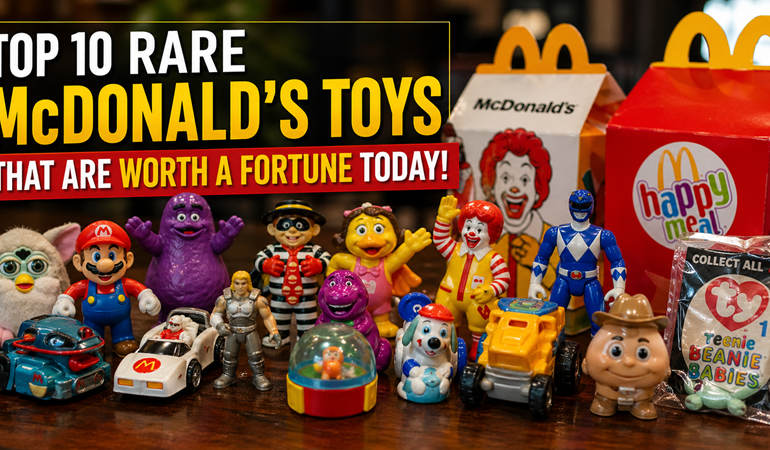

For decades, McDonald’s Happy Meal toys were seen as disposable novelties—items meant to entertain children briefly before being forgotten. However, the rise of nostalgia-driven collecting and online resale platforms has transformed many of these toys into valuable collectibles. What once seemed insignificant has, in certain cases, become highly desirable.
The key factor behind this transformation is not just age, but survival. Most toys were heavily used, lost, or discarded, which significantly reduced the number of well-preserved examples in circulation. As a result, toys that still exist in mint condition—especially those with original packaging or as part of complete sets—can command surprisingly high prices in today’s collector market.
Below are ten notable McDonald’s toys that illustrate how ordinary promotional items evolved into sought-after collectibles.
Teenie Beanie Babies (1997)

The Teenie Beanie Babies promotion remains one of the most iconic collaborations in McDonald’s history. Released during the peak of the Beanie Baby craze, these miniature plush toys were distributed in massive quantities. At the time, many believed they would become valuable, leading to widespread hoarding.
While individual toys are still relatively common, the true value lies in complete, sealed sets. Over time, many packages were opened or damaged, making untouched collections increasingly rare. As a result, well-preserved sets can sell for several hundred dollars, particularly when accompanied by original packaging and tags. Their value is rooted not only in scarcity but also in their association with one of the largest collectible trends of the 1990s.
Inspector Gadget Complete Set (1995)

The Inspector Gadget toy line stands out for its unconventional design. Each Happy Meal included a different component of the character, such as limbs, accessories, or the iconic helicopter hat. To assemble a complete figure, customers needed to collect multiple pieces.
This fragmented distribution model significantly impacted long-term availability. Today, most surviving toys are incomplete, which makes fully assembled sets comparatively rare. Collectors are willing to pay a premium for complete versions, particularly those in good condition, as they represent both a nostalgic item and a challenging collectible.
McDonald’s Changeables (Late 1980s)

The Changeables series is widely regarded as one of McDonald’s most innovative toy lines. These toys transformed from food items into robotic figures, offering both playability and novelty.
Released during the late 1980s, they are now considered vintage collectibles. Many were heavily used, resulting in wear and missing parts. Complete sets in good condition are therefore much harder to find. Their value is driven by a combination of age, unique design, and strong nostalgia among collectors who grew up during that era.
101 Dalmatians Full Collection (1996)

The 101 Dalmatians promotion was designed to encourage repeat purchases by offering a large number of unique figurines. Completing the full set required persistence, even at the time of release.
Decades later, assembling a complete collection has become even more difficult. Individual figures are relatively easy to find, but full or near-complete sets are far less common. This scarcity has significantly increased their value, particularly when the toys are well-preserved. The collection’s size and connection to a popular Disney film continue to drive demand.
McDonald’s Fry Camera (1998)

Unlike most Happy Meal toys, the fry-shaped camera offered actual functionality. Designed to resemble a container of French fries, it was capable of taking photographs, which made it both a novelty and a practical item.
This combination of form and function has contributed to its lasting appeal. Functional toys often attract a broader range of collectors, including those interested in vintage gadgets. Because relatively few units remain in working condition, well-preserved examples are considered particularly valuable.
McDonald’s Furby Toys (1999–2000)

Furbies were among the most recognizable toys of the late 1990s, and McDonald’s capitalized on their popularity with a series of miniature versions. Although simpler than the original electronic toys, they retained the distinctive design that made Furbies so appealing.
Their value today is closely tied to the cultural impact of the original Furby trend. Complete sets, especially those still sealed, tend to perform best in the resale market. As with many collectibles from this era, condition plays a crucial role in determining price.
Halloween Boo Buckets (1980s–1990s)

The Halloween Boo Buckets are an example of how seasonal items can become collectible over time. These plastic containers, often shaped like pumpkins or ghosts, were widely distributed during Halloween promotions.
Despite their initial popularity, many were used extensively and eventually discarded. As a result, older versions in good condition have become increasingly scarce. Their value is driven largely by nostalgia, as they are closely associated with childhood Halloween traditions.
Disney Tarzan Toy Set (1999)

Disney collaborations have historically been among the most successful Happy Meal promotions, and the Tarzan set is no exception. Released alongside the film, these toys captured a specific moment in late-1990s pop culture.
While individual toys are not particularly rare, complete sets are more difficult to assemble today. Their value is supported by the enduring popularity of Disney and the nostalgia associated with its animated films from that period.
Pokémon Happy Meal Toys (1999–2000)

The Pokémon franchise experienced explosive growth around the time these toys were released, making them highly desirable even during their initial distribution. Children often sought to collect multiple toys featuring different characters.
Today, certain pieces—particularly rare variants or complete sets—continue to attract strong interest from collectors. The ongoing popularity of Pokémon as a global brand ensures that demand remains steady, which helps sustain their value over time.
Snoopy World Tour Set (1998)

The Snoopy World Tour collection combined the enduring appeal of the Peanuts character with international themes. Each toy represented Snoopy in a different cultural setting, making the collection both distinctive and visually appealing.
While individual pieces are relatively accessible, complete sets are significantly harder to find. This imbalance contributes to their value, as collectors often prioritize acquiring entire collections rather than single items.
When Toys Became More Than Toys
Not all valuable McDonald’s toys were simple figurines. Some stood out because they did something unexpected.
Take the famous fries-shaped camera, for example. At first glance, it looked like a typical novelty item. But it was actually a working camera, which made it both unusual and highly collectible. Items like this blur the line between toy and gadget, and that uniqueness tends to attract serious collectors.
Similarly, the Furby toys released around 1999 capitalized on one of the biggest toy crazes of the decade. While the McDonald’s versions were smaller and simpler, they still carried the same cultural weight. Today, complete sets in good condition continue to sell well because they represent a moment when Furby was everywhere.
Even something as simple as Halloween Boo Buckets has gained value over time. These pumpkin-shaped containers were never meant to be rare, but their seasonal nature and nostalgic appeal have made them collectible decades later.
The Reality Behind “Rare” Toys
It’s worth noting that not every old McDonald’s toy is valuable—and this is where many people get it wrong.
Mass production plays a huge role in determining value. Some toys were produced in such large quantities that they are still easy to find today, which keeps prices low. Others became valuable not because they were rare at the time, but because so few survived in good condition.
In fact, many collectors emphasize that the real money is rarely in a single toy. Instead, it’s usually in complete, well-preserved sets. This is why something that originally cost almost nothing can now sell for hundreds—it’s not the toy itself, but the difficulty of finding it intact years later.
A Growing Collector’s Market
What makes this topic even more interesting is that the market is still evolving. As more people rediscover childhood memories, demand continues to grow. Online platforms like eBay have made it easier than ever for buyers and sellers to connect, which has further increased visibility and prices.
In some cases, unusual variations—such as production errors or limited releases—can push prices even higher. While these are rare, they highlight how unpredictable the collectibles market can be.
Understanding the Value Behind These Toys
What unites all of these examples is not their original cost or intended purpose, but the way their value evolved over time. Factors such as rarity, condition, and cultural relevance have transformed them from simple promotional items into collectibles.
It is also important to recognize that value is not guaranteed. Many McDonald’s toys remain inexpensive due to high production numbers and limited demand. However, those that combine strong nostalgia with limited availability—particularly in excellent condition—have demonstrated consistent appeal in the resale market.
For anyone who still owns old Happy Meal toys, this serves as a reminder to take a closer look. While most may hold only sentimental value, a select few could be worth significantly more than expected.
McDonald’s Most Valuable Toys: What Makes Them So Expensive Today
When people think about valuable collectibles, they usually imagine rare coins, vintage cars, or fine art—not plastic toys from a fast-food meal. Yet over time, McDonald’s has unintentionally created a niche market where certain Happy Meal toys have become surprisingly lucrative assets.
The most valuable McDonald’s toys are not always the oldest or the flashiest. Instead, their worth is shaped by a combination of rarity, condition, and cultural relevance. For instance, toys that were released for a limited time or pulled from circulation quickly tend to become highly sought after. Even manufacturing errors—such as misprints or unusual color variations—can significantly boost value, turning an ordinary toy into a collector’s prize.
Another major factor is packaging. A toy that remains sealed in its original wrapper can sell for several times more than one that has been opened. Collectors place immense importance on authenticity and preservation, which is why untouched sets often command premium prices in auctions and online marketplaces.
Pop culture plays an equally important role. Collaborations with iconic brands like The Walt Disney Company or franchises such as Super Mario Bros. tend to hold their value longer. These toys appeal not only to collectors but also to fans who associate them with memorable moments from their childhood.
In recent years, the value of these toys has also been influenced by the rise of online resale platforms. Collectors from around the world can now easily buy, sell, and showcase rare items, increasing visibility and demand. As nostalgia continues to grow—especially among millennials—these once-forgotten Happy Meal toys are gaining recognition as legitimate collectibles.
Ultimately, the most valuable McDonald’s toys represent more than just rarity. They capture a moment in time, blending childhood memories with the thrill of discovery—something collectors are always willing to pay for.