






10 Everyday Mysteries Scientists Still Don’t Understand
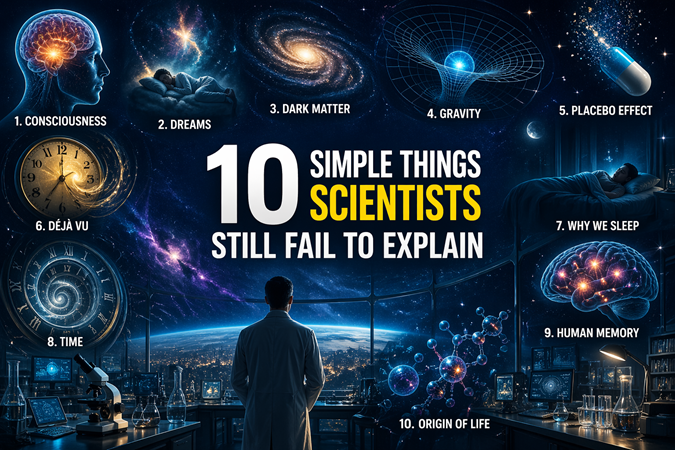

We live in a world where science can map the human genome, explore distant planets, and build intelligent machines. It feels like we’re close to understanding everything. But look a little closer, and you’ll realize something surprising—some of the simplest things around us are still not fully understood.
Not complex galaxies or black holes, but everyday experiences like dreams, consciousness, and even gravity still raise unanswered questions. That’s what makes science exciting. It’s not just about answers, but about the mysteries that keep pushing us forward.
In 2026, despite rapid advancements, these questions remain open—and deeply fascinating.
Why Simple Things Are Often the Hardest to Explain
Science often explains mechanisms, but deeper meaning is harder to capture. Fields like Quantum Mechanics and Neuroscience have advanced rapidly, yet they continue to uncover more questions than answers.
What seems simple on the surface often hides layers of complexity underneath.
10 Simple Things Scientists Still Fail to Explain
1. Consciousness: The Mystery of Being Aware
You know you exist. You can think, feel, and experience the world. But what creates that awareness? Despite advances in Neuroscience, scientists still don’t understand how brain activity turns into subjective experience. This puzzle, often called the “hard problem,” remains unsolved even with cutting-edge research in 2026.
2. Dreams: The Brain’s Night-Time Stories
Dreams can be vivid, emotional, and sometimes completely bizarre. Scientists know they occur during REM Sleep, but the purpose behind them is still debated. Some believe dreams help process emotions, while others think they are just random brain activity. No single explanation fully fits.
3. Dark Matter: The Invisible Universe
A large portion of the universe is made up of something we cannot see, touch, or directly detect. Known as Dark Matter, it influences how galaxies move, yet scientists still don’t know what it actually is. Even in 2026, it remains one of the biggest cosmic mysteries.
4. Gravity: Why Does It Exist?
We understand how gravity works thanks to Theory of Relativity, but why it exists at all is still unclear. Why do objects attract each other? What causes this fundamental force? Scientists can measure it with precision, yet its deeper nature remains unknown.
5. Placebo Effect: The Power of Belief
Sometimes, people feel better after taking a treatment that has no active ingredients. This phenomenon, known as the Placebo Effect, shows how powerful the mind can be. But how belief alone can trigger real physical changes is still not fully understood.
6. Déjà Vu: The Feeling You’ve Been Here Before
That strange moment when you feel like you’ve already experienced something is called Déjà Vu. Scientists have theories involving memory glitches or brain processing delays, but no definitive explanation exists. It remains a fascinating puzzle of the human mind.
7. Why We Sleep: More Than Just Rest
Sleep is essential for survival, yet its exact purpose isn’t completely clear. Research shows it supports memory, repair, and brain function, but why evolution made sleep so necessary is still debated. Scientists continue to explore this mystery using modern sleep studies.
8. Time: What Is It Really?
We experience time constantly, yet defining it is incredibly difficult. According to Theory of Relativity, time can slow down or speed up depending on conditions. But what time actually is—beyond measurement—remains an open question in physics.
9. Human Memory: Why Do We Forget?
Memory allows us to store experiences, but it’s far from perfect. Why do we forget important moments while remembering trivial ones? Scientists studying Neuroscience still don’t fully understand how memories are formed, stored, and lost over time.
10. The Origin of Life: How Did It All Begin?
Perhaps the biggest mystery of all is how life started. Scientists have proposed many theories, but none fully explain how non-living matter turned into living organisms. Even with advanced research in 2026, the exact process remains unknown.
What These Mysteries Mean for the Future
These unanswered questions are not signs of failure—they are opportunities. Every mystery pushes science forward, inspiring new research, technologies, and ways of thinking.
In fact, some of today’s mysteries could become tomorrow’s breakthroughs. Just as past generations solved problems once thought impossible, future scientists may unlock these secrets.
Conclusion: Curiosity Is the Real Power of Science
Science isn’t just about having answers. It’s about asking better questions. The fact that these simple things remain unexplained is what keeps curiosity alive.
In a world that feels increasingly understood, these mysteries remind us that there is still so much to discover. And that’s what makes the journey of science truly exciting.