






10 Proven Study Techniques Backed by Science (With Examples)

If you have ever spent hours studying only to forget everything during an exam, you are not alone. The problem is not how hard you study, but how you study. Modern research in cognitive science and learning psychology shows that certain techniques are far more effective than others. Yet, many students still rely on outdated methods like rereading notes or highlighting textbooks, which create the illusion of learning without real retention.
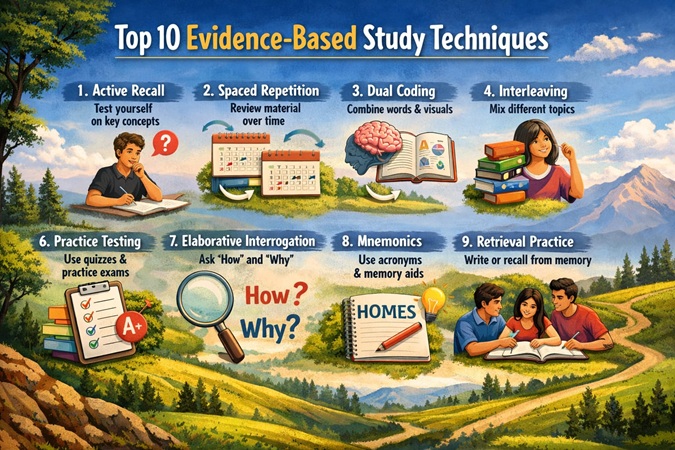
This guide on top 10 evidence-based study techniques with examples will help you study smarter, not harder. These methods are backed by research and used by top-performing students worldwide. Each technique is explained in a practical, easy-to-follow way so you can apply it immediately.
1. Active Recall
Active recall is one of the most powerful learning techniques. Instead of passively reviewing information, you actively try to remember it from memory.
For example, after reading a chapter, close your book and write down everything you remember. You can also ask yourself questions or use flashcards. This process strengthens memory by forcing your brain to retrieve information, which improves long-term retention.
2. Spaced Repetition
Spaced repetition involves reviewing information at increasing intervals over time rather than cramming everything in one session.
For instance, you might review a topic today, then again after one day, three days, and a week. This method works because it aligns with how memory naturally decays, helping you reinforce information just before you forget it.
3. The Feynman Technique
The Feynman Technique is based on a simple idea, if you can explain something clearly, you truly understand it.
Start by learning a concept, then explain it in simple language as if you are teaching a beginner. If you get stuck, go back and review the material. For example, if you are studying biology, try explaining a process like photosynthesis in your own words without using complex terms.
4. Interleaved Practice
Instead of studying one topic for a long time, interleaved practice involves mixing different subjects or types of problems in one session.
For example, instead of solving only algebra problems, you might alternate between algebra, geometry, and statistics. This approach improves problem-solving skills and helps your brain learn when to apply the right method.
5. Practice Testing
Testing yourself is not just for exams, it is a learning tool. Practice testing strengthens memory and helps identify weak areas.
You can use past papers, quizzes, or create your own questions. For example, after studying history, write down possible exam questions and answer them without looking at your notes. This builds confidence and improves recall under pressure.
6. Elaboration
Elaboration means connecting new information to what you already know. It involves asking questions like why, how, and what if.
For instance, if you are learning about a scientific concept, try relating it to real-life situations. If you are studying economics, connect theories to current events. This deeper processing makes information more meaningful and easier to remember.
7. Dual Coding
Dual coding combines verbal and visual learning. Instead of relying only on text, you use diagrams, charts, and images to understand concepts.
For example, when studying a process, draw a flowchart or diagram. If you are learning anatomy, sketch the structure along with labeling. This method engages multiple parts of the brain, making learning more effective.
8. Chunking
Chunking involves breaking down complex information into smaller, manageable parts.
For example, instead of memorizing a long list of facts, group them into categories. If you are learning a long number sequence, divide it into smaller chunks. This technique reduces cognitive load and makes information easier to process.
9. Pomodoro Technique
The Pomodoro Technique focuses on managing time effectively by studying in short, focused sessions followed by breaks.
A common approach is to study for 25 minutes and then take a 5-minute break. After four sessions, take a longer break. This method improves concentration and prevents burnout, especially during long study hours.
10. Self Explanation
Self explanation involves explaining each step of your learning process to yourself as you study.
For example, while solving a math problem, talk through each step and explain why you are doing it. This helps you understand the logic behind the solution rather than just memorizing steps.
Why These Techniques Work
These techniques are effective because they align with how the brain learns. Methods like active recall and spaced repetition strengthen memory pathways, while techniques like dual coding and elaboration improve understanding.
Unlike passive learning methods, these strategies require effort, which is exactly what makes them powerful. When your brain works harder to process information, it remembers it better.
How to Combine These Techniques for Best Results
You do not need to use all techniques at once. Start by combining a few that work well together. For example, you can use active recall with spaced repetition for memorization, and the Feynman Technique for understanding concepts.
Over time, build a study system that suits your learning style. You can also explore related topics like productivity strategies and time management tips to enhance your routine.
Conclusion
Mastering effective study techniques can completely transform your learning experience. Instead of feeling overwhelmed or unproductive, you can study with clarity and confidence.
These top 10 evidence-based study techniques with examples are not just theories, they are practical tools you can start using today. The key is consistency. Even small changes in how you study can lead to significant improvements over time.
Start with one technique, apply it to your next study session, and observe the difference. With the right approach, learning becomes not only easier but also more enjoyable and rewarding.